
EcomTalent Ad Bounties flip the one thing every UGC creator gets wrong about how they get paid. Picture the moment. You filmed the video. You held the product to the light, hit your three talking points, nailed the hook. You uploaded the file, sent the invoice, got the flat fee. Then the notification goes quiet. The brand takes your clip, drops it into a paid campaign, and that single ad spends the next several months printing sales across cold traffic. You watch it run. You made it. And you never see another cent from it.
That is the wound. Not the filming. The ceiling. You built the machine and handed away the keys for a hundred bucks. This article walks the entire Ad Bounty loop end to end, brief to payout, so you can see where the money enters, how it is calculated, and where the catch hides. No hype. A mechanism.
What EcomTalent Actually Is, No Fluff
EcomTalent is a paid community and training program for UGC and performance ad creators who want to make ads for real ecommerce brands and get paid on results. It is run by Karlo, handle @karlocreates, a solo operator whose bio reads "scaling ecom brands with high-converting ads, showing you how to do the same." One person. Not a faceless course farm.
Inside, you get 20+ hours of beginner-friendly ad-creative training, a member community, and access to the thing this article is about: the Ad Bounty loop, where pre-vetted brands post briefs and you earn a percentage of the sales your ad drives. At research time the listing showed 848 members, a 5.0 star rating, and 284 reviews. Verify the current numbers on the Whop listing yourself before you decide anything. Those figures move.
One thing it is not. EcomTalent is not a dropshipping course. It is not a Shopify store-building mentorship. You are not being taught to open a store and pray for a winning product. The vertical is UGC and performance ad creative for ecommerce brands. You make the ads. Brands sell the products. That distinction matters, and I will come back to it.
Who It Is For, And Who Should Leave
This is for you if you can hold a phone steady, follow a brief, and iterate. If you want your work to keep paying after you clock out. If you already do flat-rate UGC and you are quietly furious that your best-performing clip made the brand a fortune and made you one flat invoice. If you are a beginner willing to trade 20+ hours of training and real reps for a shot at a compounding payout instead of a tip.
Leave if you want guaranteed income by Friday. Ad Bounties are performance pay, which means the ad has to actually drive sales for you to earn on it. Some ads land. Some do not. Leave if you refuse to make ten videos to find the one that prints. Leave if you want someone to hand you a client list and a fixed hourly rate. That is a staffing agency, not this. And leave if you were looking for a dropshipping store builder, because you are in the wrong room.
Still here? Good. The costly belief is next, and it is the one keeping most creators broke.
Check the live listing before you join. Confirm the current price, proof, and terms on Whop, then decide whether you will actually submit ads.
See EcomTalent on Whop ->The Costly Belief That Caps Your Income
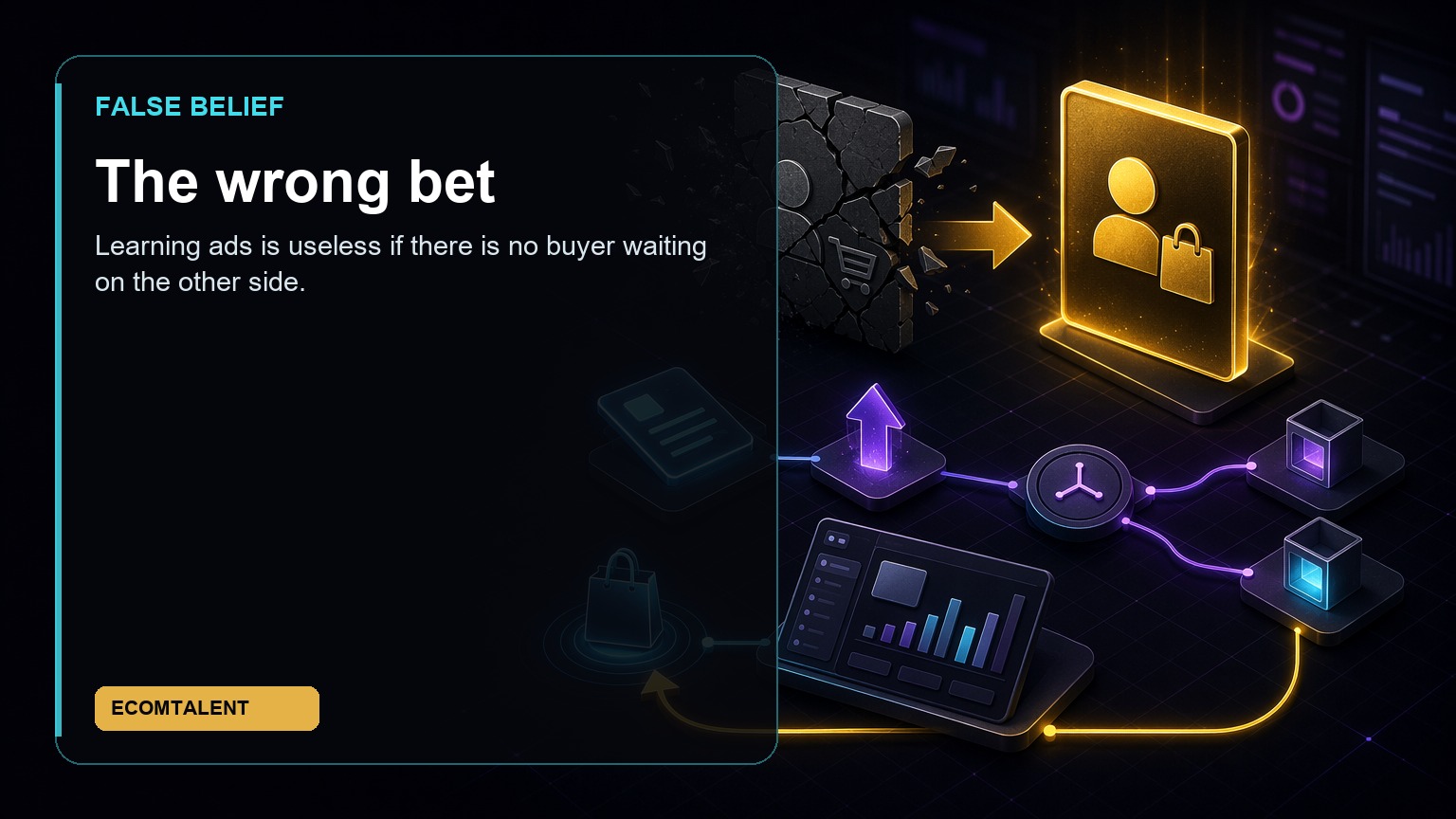
Here is the lie, stated plainly, the one the flat-fee industry needs you to keep believing:
"UGC means you get paid once to film a video and then it is over."
You have felt this as normal. You quote a rate. You deliver a file. The transaction closes like a door. Fifty dollars, a hundred, maybe one-fifty for a good one, and the relationship ends at the handoff. The reported going rate for flat per-video UGC commonly sits somewhere around $50 to $150 a clip, varies widely by niche and creator, and that number is the whole story. You are a vending machine. Insert brief, receive video, payment complete.
Now watch what the brand does with your file. They test it. If it converts, they scale it. They pour ad spend behind the exact thirty seconds you shot, and that creative can run for months, spending heavily every day and returning a multiple of it. Your video is now a revenue asset on someone else's balance sheet. You are not on that balance sheet. You got the flat fee and a door closing.
That is the expensive part of the lie. Not that flat fees are small. That flat fees sever you from the upside at the exact moment the upside begins. The ad's whole life happens after your paycheck clears. You are paid for the filming and disconnected from the selling, and the selling is where the money lives.
The True Belief, Installed In One Number
Here is what is actually true, and it is the spine of this piece:
The Ad Bounty is a performance model: your ad can run for months and pay a percentage of every sale it generates while it lives.
Not a fee. A stake. You do not sell the video and walk. You keep a claim on what the video earns, for as long as the brand keeps running it. The filming is the entry point, not the exit.
Put the two side by side and the ceiling disappears. Flat per-video UGC pays a one-time reported $50 to $150 and stops. The Ad Bounty pays an open-ended percentage of every sale the ad drives, and it keeps paying while the ad runs, which for a winner can reportedly stretch across many months. One number is fixed and closes. The other is uncapped and compounds. That is the whole reframe. A tip versus a royalty. Once you see the difference you cannot unsee it, and you will never quote a flat rate the same way again.
The Ad Bounty Loop: Brief To Payout, Step By Step
Use the same filter before you join. Check the live Whop listing, confirm the current price and proof, then decide whether you will actually submit ads.
Check EcomTalent on Whop ->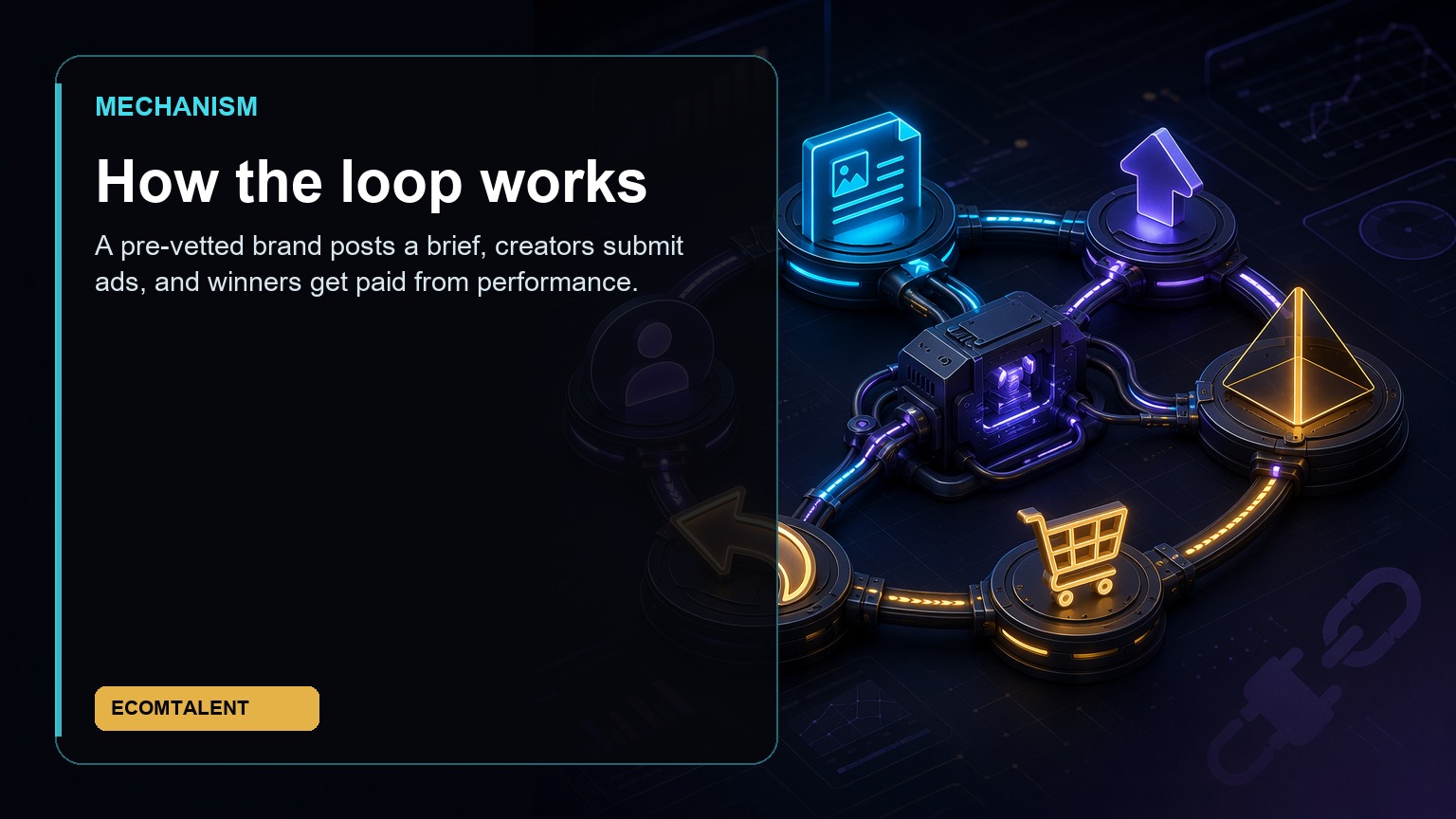
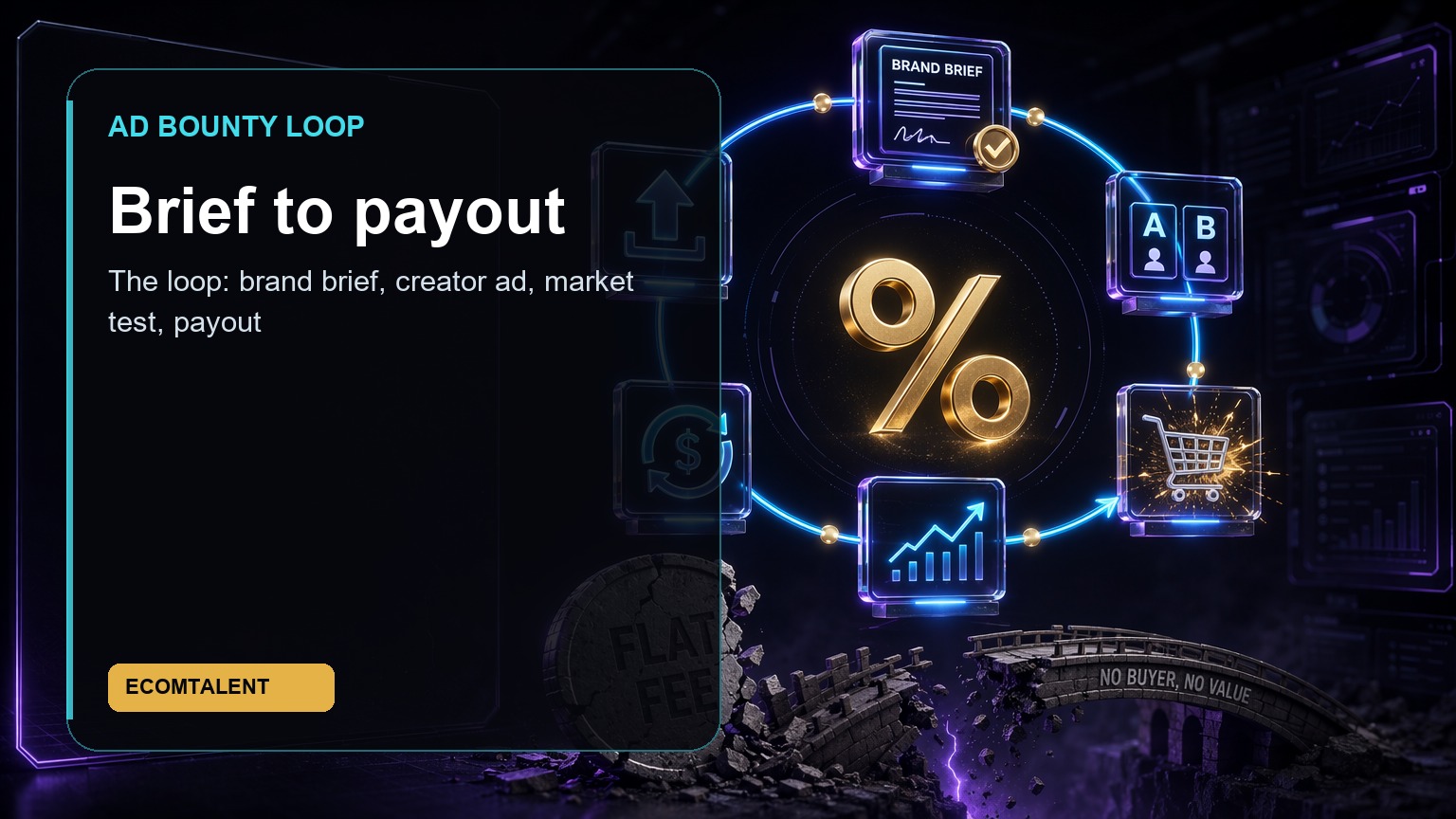
Now the mechanism. This is the part search brought you here for. Here is the loop EcomTalent runs, in order, with the money marked.
- A pre-vetted ecom brand posts a brief. Not a random guru. A real brand that EcomTalent has screened, describing the product, the angles they want tested, and the format. This is the door opening. The brand brings demand; you bring the creative.
- You create the ad. You take the brief and shoot it. Hook, demonstration, offer, whatever the brief calls for, built on what the 20+ hours of training taught you about ads that convert instead of ads that just look nice.
- The brand tests it in market. Your ad goes live in a real paid campaign against real cold traffic. This is the judge. Not the brand's taste, not your ego. The market decides whether the creative sells.
- If the ad drives sales, you earn a percentage of every sale it generates. This is the money line. Payment is not for the file. Payment is for performance. Every sale the ad produces pays you a cut, and the cut keeps coming as long as the ad runs. A winning ad can run for months, so the payout window is measured in months, not in one invoice.
- Top performers get hired directly by brands on monthly retainers. The bounty is the audition. Land enough winners and brands pull you out of the pool and put you on a recurring retainer. The one-off becomes a relationship. The tip becomes a salary.
Read the loop top to bottom and notice where the flat-fee model amputates you: right after step two. In the old world you get paid at the handoff and vanish before step three even happens. In the Ad Bounty loop, step three is where your income starts. The brand testing your ad is not the end of your involvement. It is the ignition.
Proof, And The Buyer Math In Your Real Currency
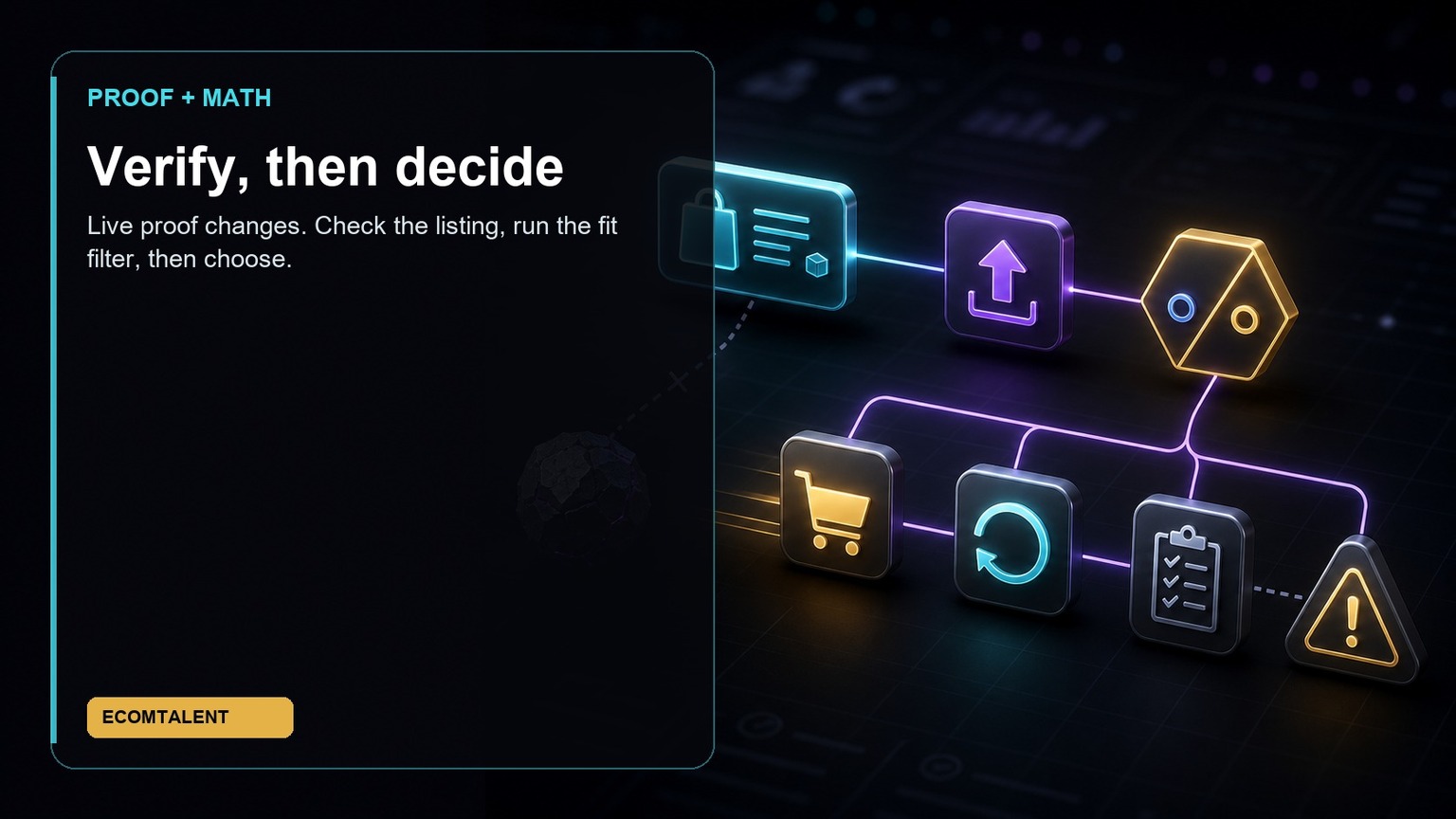
Let me be careful here, because this is where dishonest writers invent numbers. I will not. EcomTalent has not published a fixed bounty percentage, and I will not fabricate one. What is verified is the structure: a percentage of every sale, open-ended, running while the ad lives. The demand side is verified too. Brands pay $997 a month on a waitlisted tier to hire from this trained creator pool. That is real money from the buyer side, and it tells you the pool has value someone is paying to reach.
So let me show the math as a framework, using clearly labeled reported and illustrative ranges, so you can plug in your own reality. Do not read these as EcomTalent promises. They are arithmetic you control.
| Scenario | Flat UGC (reported) | Ad Bounty (structure) |
|---|---|---|
| What you are paid for | The file | The sales the file drives |
| Payment timing | Once, at delivery | Ongoing, while the ad runs |
| Typical one-time figure | $50 to $150 (varies widely) | No flat fee; percentage of sales |
| Ceiling | Fixed at the invoice | Open-ended, uncapped |
| If the ad flops | You still got the flat fee | You may earn little or nothing |
| If the ad wins for months (illustrative) | Still just the flat fee | You earn on every sale, every month it runs |
| Best case outcome | Repeat flat gigs | Monthly retainer from the brand |
Now the currency that matters, dollars, framed as a decision and not a guarantee. Suppose you make ten ads under the Ad Bounty model. Reality says most will not scale. That is the honest shape of performance work. Say one lands and the brand runs it hard for several months. Under flat UGC, that winner still pays you the same reported $50 to $150 the nine losers did, because flat pay cannot tell a winner from a dud. Under the bounty, that single winner keeps paying a percentage of every sale for the life of the run while the losers cost the brand, not you. The math does not reward volume of files. It rewards one ad that sells and keeps selling. That is the entire thesis, in your bank account.
Notice what the model quietly does. It moves the risk of a flop onto the brand and the reward of a hit onto the shared line. Flat UGC does the opposite: you carry no downside and no upside. The bounty asks you to care whether the ad actually works, and then pays you when it does.
Honest Comparison: Where Ad Bounties Lose
I am not going to pretend this model wins on every axis. It does not, and a writer who tells you otherwise is selling.
Flat-rate UGC beats the Ad Bounty on certainty and speed. If you need money this week, flat pay wins, full stop. You deliver, you invoice, you get paid, done. The bounty makes you wait for the market to vote, and the market is slow and unsentimental. A staffing agency or a fixed retainer elsewhere beats it on predictability: you know the number in advance. And a high-volume flat-rate creator who cranks out twenty clips a week for guaranteed rates can, in a slow bounty stretch, out-earn a bounty creator whose ads have not caught yet.
The Ad Bounty wins on exactly one thing, but it is the thing that changes your life: the ceiling. It is the only one of these where a single good decision keeps paying you long after you made it. Everything else trades your upside for a smaller, surer number. If you never want variance, take the flat fee and close the door. If you want the door to stay open, you already know which model this is.
Where To Be Careful
Real caveats, because the reframe is only honest if the risks come with it. At least three, plainly:
- Performance pay means real risk of a zero. If your ad does not drive sales, the percentage of nothing is nothing. Unlike a flat fee, the bounty can pay you very little for a video you worked hard on. That is the deal you are accepting. Do not join expecting guaranteed income. Expect a system that pays disproportionately when you get it right.
- The exact bounty percentage and terms depend on the brief and the brand. EcomTalent has not published a universal rate, so treat any specific percentage you see quoted anywhere with suspicion unless it comes from the actual brief in front of you. Read each brief's terms before you shoot. What you earn varies and depends on performance.
- The $97 a month is a real recurring cost with no free trial. Membership is $97 per month, every month, whether or not a bounty pays out. There is no free trial and no operator refund guarantee beyond whatever the Whop platform provides by default. You are paying for training and access, not for a promised return. If you cannot see yourself putting in the reps to make the access worth $97 a month, that math does not work, and I would rather you know that now.
- Skill is the gate. The loop pays on sales, and sales come from ads that convert, which is a skill. The 20+ hours of training exist because this is learnable, but "learnable" is not "instant." Budget the time to actually get good, or the bounty stays theoretical.
The De-Risking Checklist
Before you put down $97, run this. If you cannot check most of these, wait.
- You have verified the current member count, rating, and review count on the live Whop listing yourself, rather than trusting a number in an article.
- You understand the payout is a percentage of sales, ongoing, not a flat fee, and you are comfortable with the variance that implies.
- You can commit real hours to the 20+ hours of training and then to making multiple ads, not one and done.
- You can absorb $97 a month for at least a few months while you learn, without needing a bounty to pay out immediately.
- You want to make performance ad creative for ecommerce brands specifically, and you are not secretly looking for a dropshipping or store-building course.
- You have read at least one real brief's terms, or you accept that percentages vary per brand and per brief.
- You are okay being judged by the market instead of by a client's taste, because that is who decides whether you get paid.
Check the live listing before you join. Confirm the current price, proof, and terms on Whop, then decide whether you will actually submit ads.
See EcomTalent on Whop ->The Verdict, Both Ways
Let me decide it for you, in both directions, so you are not left guessing.
Join EcomTalent if you are a creator, beginner or intermediate, who is tired of the flat-fee ceiling and willing to trade certainty for a compounding shot. If the idea of one ad paying you a percentage of every sale for months on end lights something up, and you can stomach the videos that go nowhere on the way to the one that lands, this model is built for exactly you. The $97 a month buys you training and a pipeline of pre-vetted brands posting briefs, and the demand side is real enough that brands pay $997 a month to hire from the pool you would be joining. That is the door staying open.
Skip it if you need guaranteed money now, if variance keeps you up at night, if you will not put in the reps, or if $97 a month is a strain before you have earned a cent back. Skip it if you wanted a dropshipping store builder. There is no shame in taking the flat fee and the certainty. Just do it knowing the ceiling comes with it.
The whole piece was one motif: the door. Flat UGC closes it the instant your invoice clears. The Ad Bounty is the model where the door stays open and the ad keeps walking sales through it, month after month, paying you each time it does. That is the reframe. That is the number. That is the loop, brief to payout. Now you decide which side of the door you want to stand on.
FAQ
How exactly do EcomTalent Ad Bounties pay me?
You earn a percentage of every sale the ad you created drives, paid while the ad runs. It is performance pay, not a flat fee. A brand posts a brief, you make the ad, the brand tests it in market, and if it drives sales you earn a cut of each one. A winning ad can run for months, so the payout window can last far longer than a single invoice.
What is the catch with the Ad Bounty model?
The catch is real. If your ad does not drive sales, you may earn little or nothing, because a percentage of no sales is no money. There is no flat safety net like traditional UGC. You are trading guaranteed pay for uncapped, performance-based pay, and that means some ads will not pay you at all.
How much does EcomTalent cost?
The member tier is $97 per month with no free trial and no operator refund guarantee beyond the Whop platform default. Brands who want to hire from the trained creator pool pay a separate $997 a month waitlisted tier. Verify current pricing on the Whop listing before joining.
Is EcomTalent a dropshipping or Shopify course?
No. EcomTalent is focused on UGC and performance ad creative for ecommerce brands. You learn to make ads that convert and earn on their performance. It does not teach dropshipping or building a Shopify store. If that is what you want, this is the wrong program.
How is this different from regular flat-rate UGC?
Flat-rate UGC pays a one-time reported $50 to $150 per video and ends at delivery, regardless of how well the ad performs afterward. The Ad Bounty pays an open-ended percentage of every sale for as long as the ad runs. Flat pay is a fixed tip. The bounty is a compounding stake in the ad's performance.
Can Ad Bounties become steady income?
They can, but it depends on performance and is not guaranteed. Top performers get hired directly by brands on monthly retainers, which turns one-off bounties into recurring income. That outcome depends on landing ads that sell, so treat retainers as an earned possibility, not a promise, and expect to make several ads before one scales.