

Performance based UGC is the reason two creators can shoot the same product, in the same kitchen, with the same phone, and walk away with wildly different paychecks. One got paid once. The other is still getting paid. Picture it. You film a 30 second ad on a Tuesday. You send the file. A hundred dollars lands in your account. The brand runs your ad for nine months, it sells six figures of product, and you never see another cent of it. You did the work that printed the money. You just signed away the part where the money keeps printing.
That is the trap. Not a lack of talent. Not a bad camera. A pay model that caps you the second you hit send. This piece is about the two ways UGC creators get paid, why one of them quietly steals your best work, and how a results-tied model changes the math. Read both sides. Then decide with your eyes open.
What UGC pay actually is, no fluff
UGC means user generated content: short, native-feeling ad creative that a real person films for a brand, usually on a phone, usually to run as a paid ad. Someone has to pay the creator for that work. There are two clean ways to do it.
Flat fee. You agree on a price per video before you shoot. You deliver. You get paid that number. Done. A reported common range for a single UGC video runs anywhere from $50 to several hundred dollars depending on the creator, the niche, and the deliverables, and rates vary widely. The transaction ends on delivery. Whatever the ad does after that, in market, over months, is not your business and not your income.
Performance pay. Your money is tied to what the ad produces. Instead of a fixed number on delivery, you earn a percentage of the sales your ad drives, for as long as it drives them. If the ad flops, you earn little. If the ad wins, you earn on every sale it generates, and some winning ads run for months. The ceiling moves with the result, not with the calendar.
That is the whole debate in two paragraphs. The rest of this article is about what those two structures do to your income over a year, and which villain hides inside the one that feels safer.
Who this model is for, and who should walk away
Performance pay is not for everyone. Say that out loud before anyone spends a dollar.
It fits you if: you can shoot volume, you can stomach a slower first month, you want upside on your best work instead of a flat ceiling, and you are willing to learn what makes an ad convert instead of just what makes it look nice. You treat this like building an asset, not clocking a shift.
Walk away if: you need guaranteed money this Friday to cover rent, full stop. Performance pay pays on results, and results take time to compound. If you have zero runway, take flat gigs until you do. Also walk away if you refuse to study conversion, hate feedback, or want a boss to hand you a script and a fixed check. Nothing wrong with that. It is just a different job.
And one hard line on category. The performance model we describe here lives in UGC and performance ad creative for ecommerce brands. It is not dropshipping. It is not building a Shopify store. If you came looking for a store-building course, this is the wrong page, and we would rather lose the click than sell you the wrong thing.
Check the live listing before you join. Confirm the current price, proof, and terms on Whop, then decide whether you will actually submit ads.
See EcomTalent on Whop ->The costly belief that caps your income
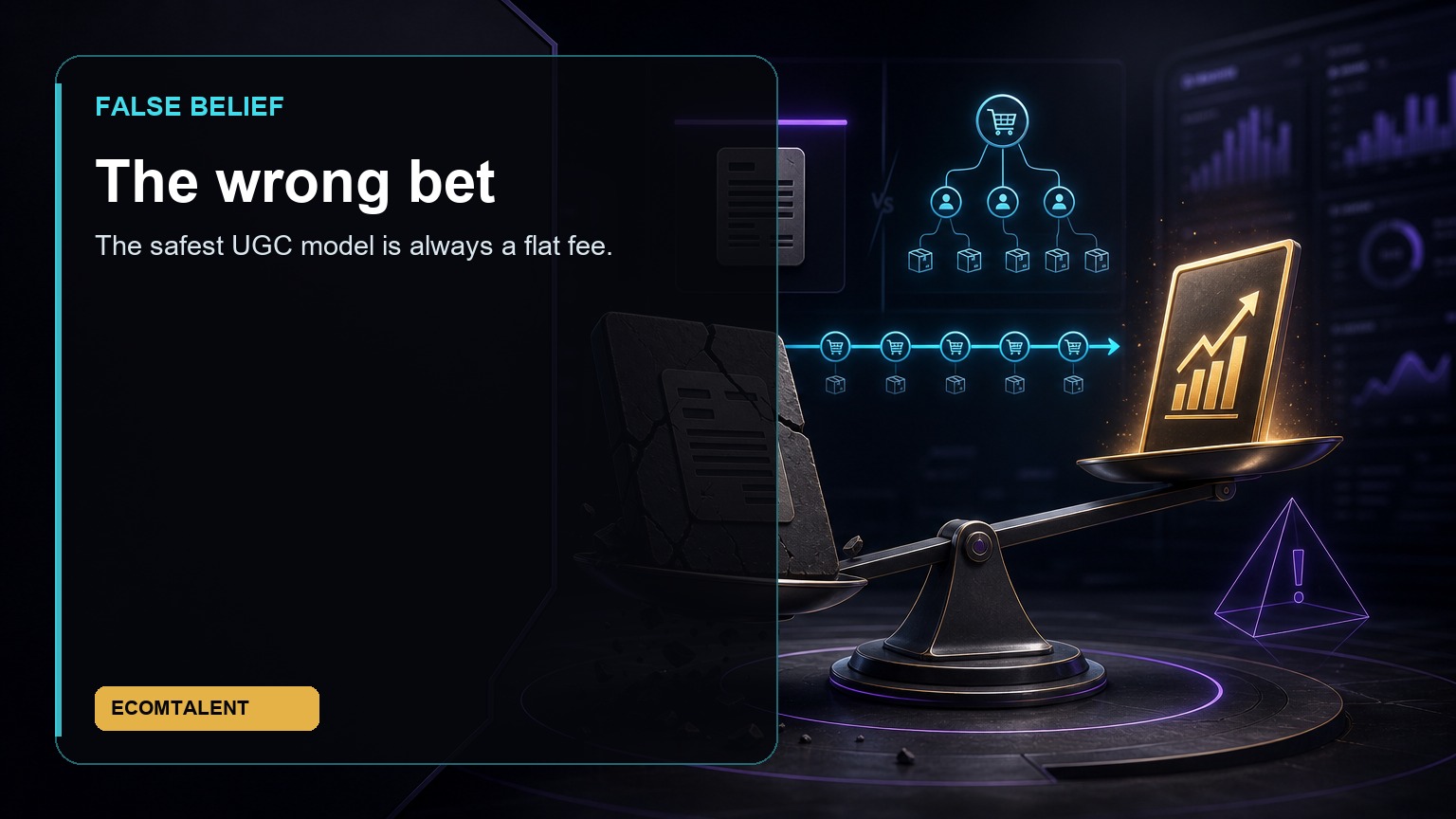
Here is the lie, and it is expensive.
"A flat per-video fee is the only way UGC creators get paid."
Almost every new creator believes this because it is the only model they have ever been shown. You Google "how much for a UGC video," you get a per-video number, and the number becomes the whole world. Price per deliverable. That is the ceiling you build your business under without ever choosing it.
Watch what that ceiling does. A flat fee pays you for your time and file. It does not pay you for your result. So the moment your ad becomes valuable, genuinely valuable, driving sales day after day, you have already been paid in full and you are locked out of the value you created. The better your ad performs, the more you lose by having sold it flat. Read that again. Under flat fees, your best work is where you leave the most money on the table.
The villain here is not the brand that paid you $100. The villain is the industry default that trained you to think one flat rate per video is the ceiling of what a creator can earn, so you never ask for a cut of the outcome. That default keeps creators interchangeable, replaceable, and cheap. It benefits everyone except the person holding the camera.
Now the true belief, the one worth installing in its place:
Performance pay ties your income to results, so a single winning ad can out-earn dozens of flat gigs.
You are not being paid for a file anymore. You are being paid for a machine you built that sells product. Machines that sell product are worth a percentage of the sales, not a one-time flat rate. That is not a hype claim. It is what happens when you get paid on the back end instead of only the front.
The mechanism: the Ad Bounty loop
Use the same filter before you join. Check the live Whop listing, confirm the current price and proof, then decide whether you will actually submit ads.
Check EcomTalent on Whop ->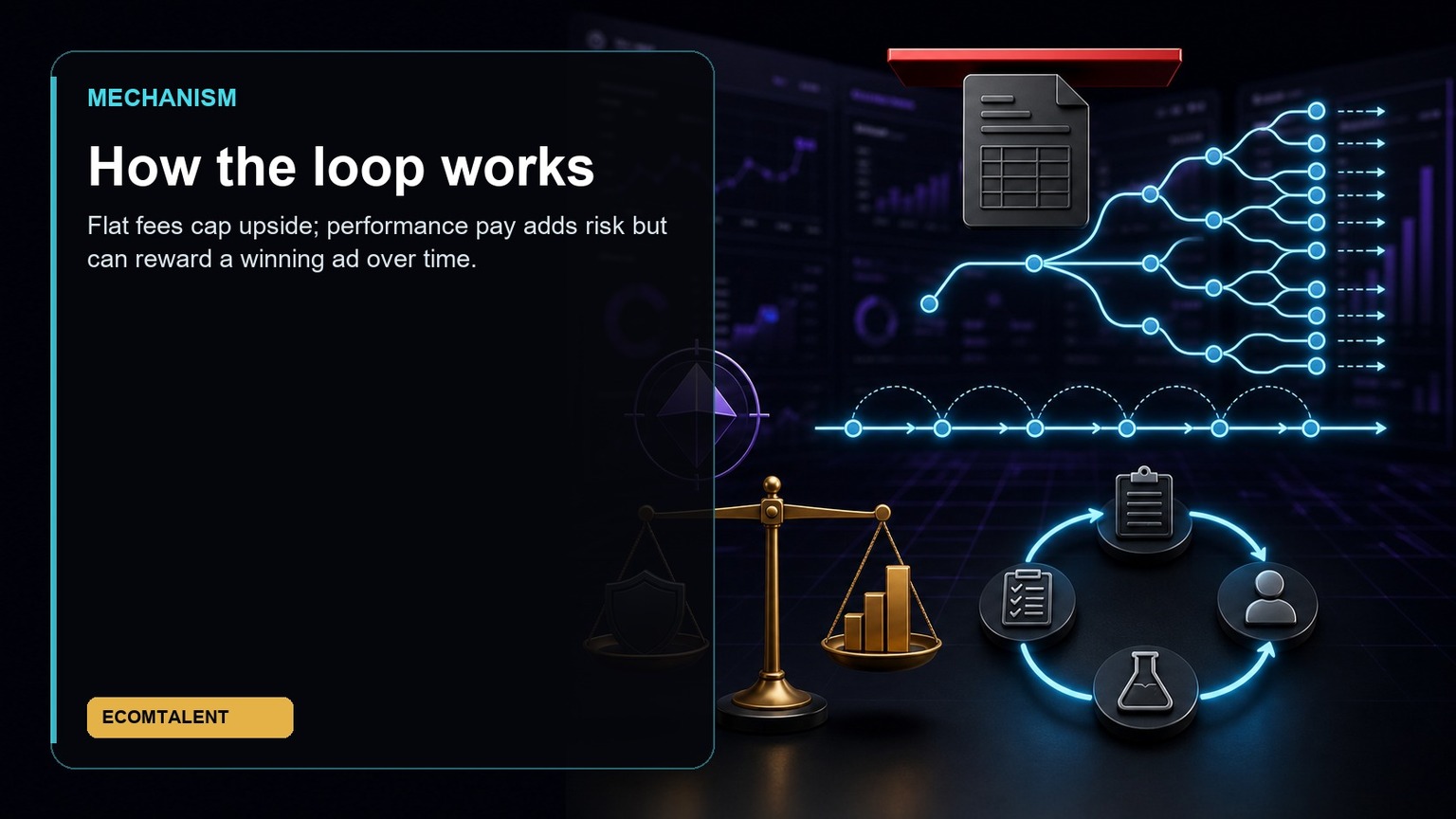
Belief is cheap without a mechanism. Here is the named, numbered engine that makes performance pay real, the way it runs inside EcomTalent's model. It is called the Ad Bounty loop.
- A pre-vetted ecom brand posts a brief. A real brand, screened in advance, drops what it needs: product, angle, target buyer.
- A member creates the ad. You take the brief and shoot the creative. This is the part you already know how to do, or are learning to.
- The brand tests it in market. The ad goes live against real spend and real customers. The market votes with dollars, not opinions.
- If the ad drives sales, you earn a percentage of every sale it generates. Not a flat fee. A cut. And a winning ad can run for months, so the same 30 second file can pay you across two or three financial quarters.
- Top performers get hired directly by brands on monthly retainers. The winners graduate. A proven ad becomes a proven creator, and brands pay to keep you.
Look at what changed. In a flat deal, steps 3 and 4 are none of your business, because you were paid at step 2 and shown the door. The Ad Bounty loop keeps you inside the part where the money actually lives: the market, over time. The brief, the shoot, the test, the cut, the retainer. That is the loop.
And there is a demand-side signal worth naming, because it is easy to fake and this one is not. Brands pay a separate $997/month brand tier (waitlist) for the right to hire from this trained creator pool. When the buyers of your work are paying almost a thousand dollars a month just to reach you, the demand for performance creators is not theoretical. Someone is paying to stand on the other side of the loop.
Proof and buyer math: run the number yourself
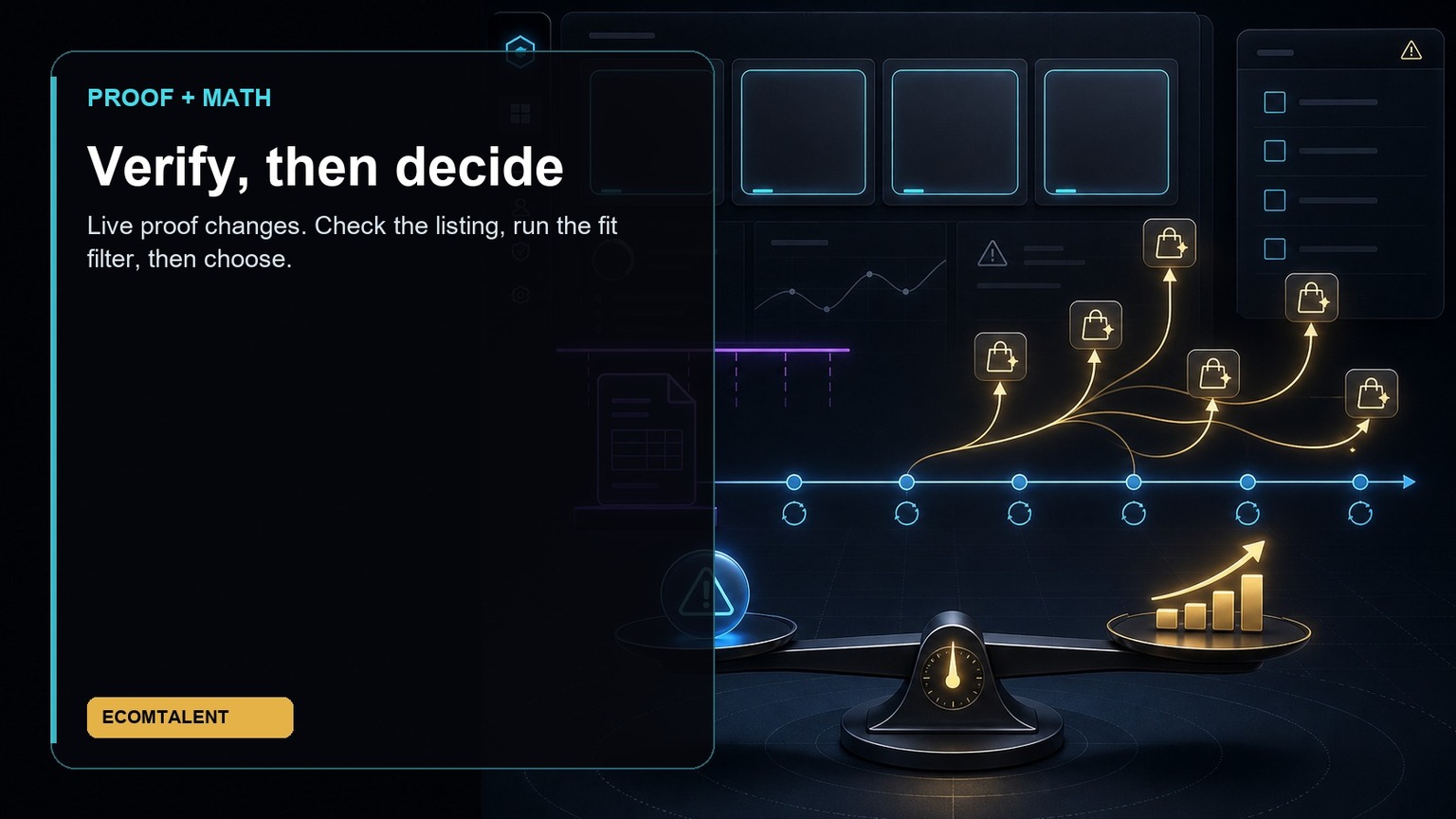
Now the number that settles the argument. Keep it simple and keep it honest: these figures are illustrative, using a reported flat rate, not a promise of what you will earn. Your results depend on the ad, the brand, and the market.
Say a flat gig pays a reported $100 per video. You grind out ten of them. Ten shoots, ten edits, ten deliveries, ten invoices.
$100 times 10 gigs. One thousand dollars. And then it stops. Every one of those ads could run for months and sell well, and your income from all ten is capped, forever, at a thousand dollars. You already spent the money by the time the ads started working.
Now put that same effort into the other model. One ad. Not ten. One, tied to a percentage of sales, running for months. If it drives real volume, a percentage of months of sales on a single winning product can, depending on performance, exceed the entire flat-fee stack, from far fewer shoots. One machine that pays across a year can out-earn a dozen files that paid once. That is the point of the number: not that performance always wins, but that its ceiling is not a ceiling at all.
| Dimension | Flat per-video fee | Performance-based UGC (Ad Bounty loop) |
|---|---|---|
| When you get paid | Once, on delivery | Ongoing, as the ad drives sales |
| Income ceiling | Capped at the agreed rate | Moves with the result, no fixed cap |
| Your best ad | You lose the upside you created | You keep earning on it for months |
| Your worst ad | Still paid in full | Earns little, downside is real |
| Speed of first dollar | Fast, paid on delivery | Slower, pays as results compound |
| What you are selling | A file and your time | An asset that sells product |
| Long-run relationship | Ends at delivery | Winners get retainers |
Read the table as a trade, not a verdict. Flat fees buy you certainty and speed. Performance buys you upside and a ceiling that lifts. Neither line is a lie. They are built for different creators and different seasons of a career.
Where flat fees actually win
Honesty is the whole brand here, so let us say plainly where the flat model beats performance. There are real cases.
Flat fees win on certainty. You know the number before you shoot. You can plan rent around it. Performance pay cannot promise you a specific dollar figure this month, because it depends on how the ad performs, and some ads simply do not.
Flat fees win on speed. Deliver Tuesday, paid Tuesday or on net terms. No waiting for sales to compound. If your runway is thin, that speed is not a luxury, it is survival.
Flat fees win when the brand, product, or offer is weak. If a percentage of sales is a percentage of nothing, you would rather have taken the flat check. Performance pay rewards you when the brand and product are good enough to convert, and punishes you when they are not, even if your creative was excellent. That is a genuine risk you carry that a flat creator does not.
So the smart creator does not pick a religion. Many run both. Flat gigs for cash flow now, performance ads for upside later. The mistake is not taking flat work. The mistake is believing flat is the only option and never building a single asset that pays you twice.
Where to be careful
Three real caveats. No brand, program, or model is all upside, and anyone who tells you otherwise is selling.
- Performance pay has real downside. A percentage of a flop is close to nothing. If you cannot afford a slow month, or a run of ads that do not convert, you are not ready to lean on this model yet. Build a cash buffer with flat work first. This is not guaranteed income, and no honest operator will call it one.
- Verify the numbers yourself before you join anything. At research time, EcomTalent showed 848 members, a 5.0 star rating, and 284 reviews on its Whop listing, with the member tier at $97/month and no free trial. Numbers move. Open the live listing and confirm the current member count, rating, price, and terms before you pay. Do not take a review's word for a price, and note there is no operator refund guarantee stated.
- Your income depends on inputs you do not fully control. The brand's product, offer, landing page, and ad spend all move the result, and so does the market. You can shoot a genuinely great ad and still earn little because the funnel around it leaked. Performance pay means you share in the win and in the loss. Go in knowing that, not hoping around it.
A checklist to de-risk the decision
Before you commit to any performance-based UGC path, flat or program, run this list. If you cannot check most of it, wait.
- Runway. Do you have enough saved, or enough flat work, to survive a slow ramp? If no, stack flat gigs first.
- Volume. Can you shoot consistently, not once a month? Performance rewards at-bats. More quality swings, more chances at a winner.
- Willingness to learn conversion. Are you ready to study what makes an ad sell, not just look good? EcomTalent reports 20+ hours of beginner-friendly ad-creative training built for exactly this.
- Real brands on the other side. Is there actual demand from paying brands? The $997/month brand tier waitlist is one signal that demand is real. Confirm it is current.
- Clear terms. Do you understand the percentage, the tracking, and how long an ad can earn? Never sign a performance deal you cannot explain back in one sentence.
- Price sanity. $97/month for the member tier. Ninety-seven dollars. Can one flat gig a month cover that while you build? Do that math before you join, not after.
Check the live listing before you join. Confirm the current price, proof, and terms on Whop, then decide whether you will actually submit ads.
See EcomTalent on Whop ->The verdict, decided both ways
We will not hedge. Here is the call.
Buy into performance-based UGC if you can shoot volume, you have even a thin runway, and you want your best work to keep paying you instead of paying you once. If you are tired of the flat ceiling and willing to trade a slower first month for a lifting one, this is the model that matches your ambition. The Ad Bounty loop keeps you inside the part of the deal where the money lives, and a structure like EcomTalent's, at $97/month with 20+ hours of training and real brands paying to hire from the pool, is a rational place to learn it. Verify the live numbers, then move.
Skip it, for now, if you need a guaranteed check this Friday, you cannot survive a slow month, or you have no interest in learning conversion. Take flat gigs, build your buffer, sharpen your craft, and come back when you have runway. There is no shame in that order. It is the correct order.
One motif has run through this whole piece: the ad you shot on a Tuesday. Under flat fees, that Tuesday pays you once and forgets you. Under performance pay, that same Tuesday can pay you for months. Same shoot. Same phone. Same kitchen. The only thing that changed is which model you signed. Choose the one that keeps paying.
FAQ
Is performance-based UGC better than flat fees?
Neither is universally better. Flat fees win on certainty and speed. Performance pay wins on upside and a ceiling that lifts with your results. Flat pays you once for a file. Performance pays you a percentage of the sales your ad drives, for as long as it drives them. Most working creators run both: flat for cash flow, performance for upside.
How much do UGC creators actually make per video?
Reported flat rates vary widely, commonly from around $50 to several hundred dollars per video depending on niche, experience, and deliverables. Those are general industry ranges, not a promise. Performance pay does not work per video at all: you earn a percentage of the sales the ad generates, so the total depends entirely on how the ad performs in market.
What is the Ad Bounty loop?
It is the mechanism behind performance pay in EcomTalent's model. A pre-vetted ecom brand posts a brief, a member creates the ad, the brand tests it in market, and if the ad drives sales the member earns a percentage of every sale it generates. Winning ads can run for months, and top performers get hired directly by brands on monthly retainers.
How much does EcomTalent cost?
At research time the member tier was $97/month with no free trial, and a separate brand tier at $997/month by waitlist for brands hiring from the creator pool. Prices can change, so confirm the current number on the live Whop listing before joining.
Is EcomTalent a dropshipping course?
No. It is focused on UGC and performance ad creative for ecommerce brands. It is not dropshipping and not Shopify store-building. If you want to build a store, this is the wrong fit, and you should look elsewhere.
Can I lose money with performance pay?
You will not typically lose a deposit on a per-ad basis, but you carry real downside: a percentage of an ad that does not convert is close to nothing, and the result depends on the brand, product, offer, and market, not just your creative. Keep a cash buffer, ideally from flat work, before you rely on performance income. It is not guaranteed money.