

How much do UGC creators make? You have typed that question at 1 a.m. after watching a girl on your feed hold up a ring light and claim she cleared eleven thousand dollars last month filming skincare on her kitchen counter. The screenshot glows. The number is round. The caption says "no followers needed." And something in your gut tightens, because you have three phone videos, zero brand replies, and a bank balance that has not moved. That screenshot is the villain of this article. Not the creator. The screenshot.
Here is what that screenshot never shows. The month before it. The four unpaid test videos. The flat one-time fee that never repeated. The "revenue" that was really revenue minus a phone, minus lighting, minus the SD card, minus twenty hours of reshoots. A screenshot is a highlight. Highlights are not incomes. And the reason you cannot find a straight answer to "how much do UGC creators make" is that everyone selling you the dream shows you only their best frame.
Let us turn the camera around.
What UGC actually is, in one breath
UGC stands for user-generated content. In the money sense that matters here, it means short, native-looking ad creative you film for a brand: a product unboxing, a "get ready with me," a problem-solution demo, a testimonial to camera. The brand runs it as a paid ad on TikTok, Instagram, or YouTube. You are not an influencer. Nobody needs to follow you. You are a creative supplier. You make the asset. The brand buys the attention.
That distinction is the first fork in the income road, and most articles skip it. An influencer sells reach. A UGC creator sells footage. Reach is priced on audience size. Footage is priced on how well it sells. Those are two different economies, and confusing them is how beginners quote the wrong number and lose the deal.
Who this honest breakdown is for, and who should close the tab
This is for you if you are willing to treat UGC as a craft with a learning curve, film ten to fifty pieces before you are good, and read a rate as a range instead of a promise. It is for the person who wants to know the floor, not just the ceiling.
Close the tab if you want a guaranteed number. There is no guaranteed number. Close it if you believe "no experience needed" means "no skill needed." Skill is the entire variable. And close it if the only outcome you will accept is the kitchen-counter eleven-thousand screenshot, because chasing the outlier is how people quit in month two. The outlier is real for someone. It is not the plan.
Still here? Good. You are exactly who the real math rewards.
Check the live listing before you join. Confirm the current price, proof, and terms on Whop, then decide whether you will actually submit ads.
See EcomTalent on Whop ->The costly lie you have been sold

The lie: UGC is either instant ten-thousand-dollar months or it pays nothing.
This is the belief bleeding your motivation, and it is expensive because it is a trap with two jaws. Jaw one: you see the ten-thousand screenshot, expect it in week three, and quit in week four when your real number is smaller. Jaw two: you hear a friend say "I tried UGC, made forty bucks, it is a scam," and you write off an entire skill on a sample size of one bad flat-fee gig.
Both jaws are the same mistake. Both treat UGC income as a coin flip. Ten grand or nothing. Jackpot or scam.
It is not a coin flip. It is a dial.
The truth: UGC income is a wide range driven by skill, volume, and whether your pay is flat or performance. Revenue is not profit. Outliers are not typical.
Read that again, because it is the whole spine. Three dials set your number. How good your footage is. How many pieces you ship. And whether a brand pays you once, flat, or pays you a slice of what your ad earns for months. Turn those three dials and the same person moves from "forty dollars, this is a scam" to a real, repeatable income. Nobody screenshots the dial. The dial is not sexy. The dial is just true.
The two pay models, because this is where the money hides
Everything about your income comes down to which of these two checks you are cashing. Miss this and you will price yourself like a stock-footage vendor forever.
Flat fee: paid once, per video
You film a piece. The brand pays a set price. Done. The ad can run for six months and print money for them, and you see none of the upside. Reported flat rates for UGC vary widely by niche, quality, and usage rights, and public figures floating around the creator internet commonly land somewhere in a range of roughly seventy-five to a few hundred dollars per video for newer creators, with experienced creators reporting higher. Treat every one of those numbers as reported and highly variable, not as a rate card you are owed. Usage rights, exclusivity, and whitelisting can raise a flat fee. A rushed one-off with no rights lowers it.
Flat fee is predictable. That is its gift. It is also its ceiling. You get paid for your time once, and time does not scale. There are only so many videos in a week.
Performance: paid a percentage of what your ad sells
Here is the model the screenshots never explain, because it is harder to fake and slower to start. Instead of one flat check, you earn a cut of the sales your ad drives, for as long as the ad runs. A winning ad can run for six to twelve months. You film it once. It pays across all of them.
This is the difference between selling a photograph and licensing a song. Same effort to create. Wildly different tail. A flat-fee creator and a performance creator can shoot the identical video, and a year later one has been paid one time and the other has been paid on every sale that video generated. That gap is the answer to "how much do UGC creators make," and it is why the honest range is so wide it looks absurd from the outside.
Neither model is a scam. But if you only ever chase flat fees, you have capped yourself, and then you will read a performance creator's screenshot and call them a liar. They are not lying. They are on the other dial.
The Ad Bounty loop: performance pay as a machine
Use the same filter before you join. Check the live Whop listing, confirm the current price and proof, then decide whether you will actually submit ads.
Check EcomTalent on Whop ->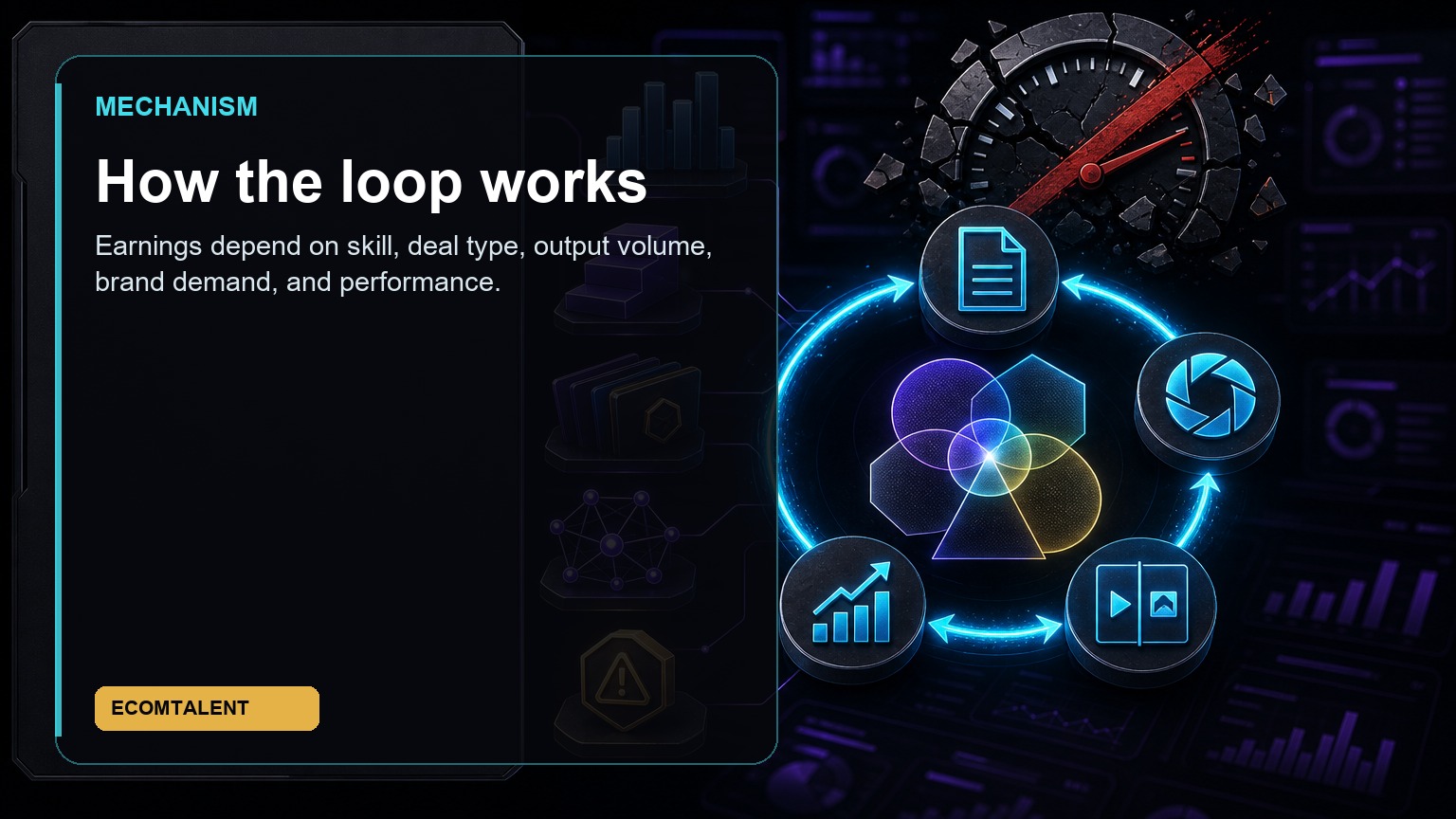
Abstract "performance pay" is easy to nod at and impossible to act on. So look at one concrete version of it. Inside EcomTalent, Karlo runs a mechanism called the Ad Bounty loop, a clean example of the performance model turned into a repeatable system instead of a lucky one-off. Here is the loop, step by step.
- A pre-vetted ecom brand posts a brief. Not a cold DM you sent into the void. A brand already paying to be there, telling you exactly what it needs.
- You create the ad. This is where your training and your reps show up. The footage is the product.
- The brand tests it in market. Real ad spend, real audience. The market votes, not a guru.
- If the ad drives sales, you earn a percentage of every sale it generates. Some of these ads run six to twelve months. You filmed once. It pays across the run.
- Top performers get hired directly by brands on monthly retainers. The loop graduates you from per-ad income into recurring client income.
Notice what the loop fixes. It fixes the cold-outreach problem, because the brief comes to you. It fixes the flat-fee ceiling, because you earn on the tail. And it fixes the "is this even a real opportunity" problem, because the demand side is verifiable, which we will get to. This is the machine version of the dial. You are not waiting for a jackpot. You are turning skill and volume into performance income on a track built for it.
Proof, and the buyer math in your real currency
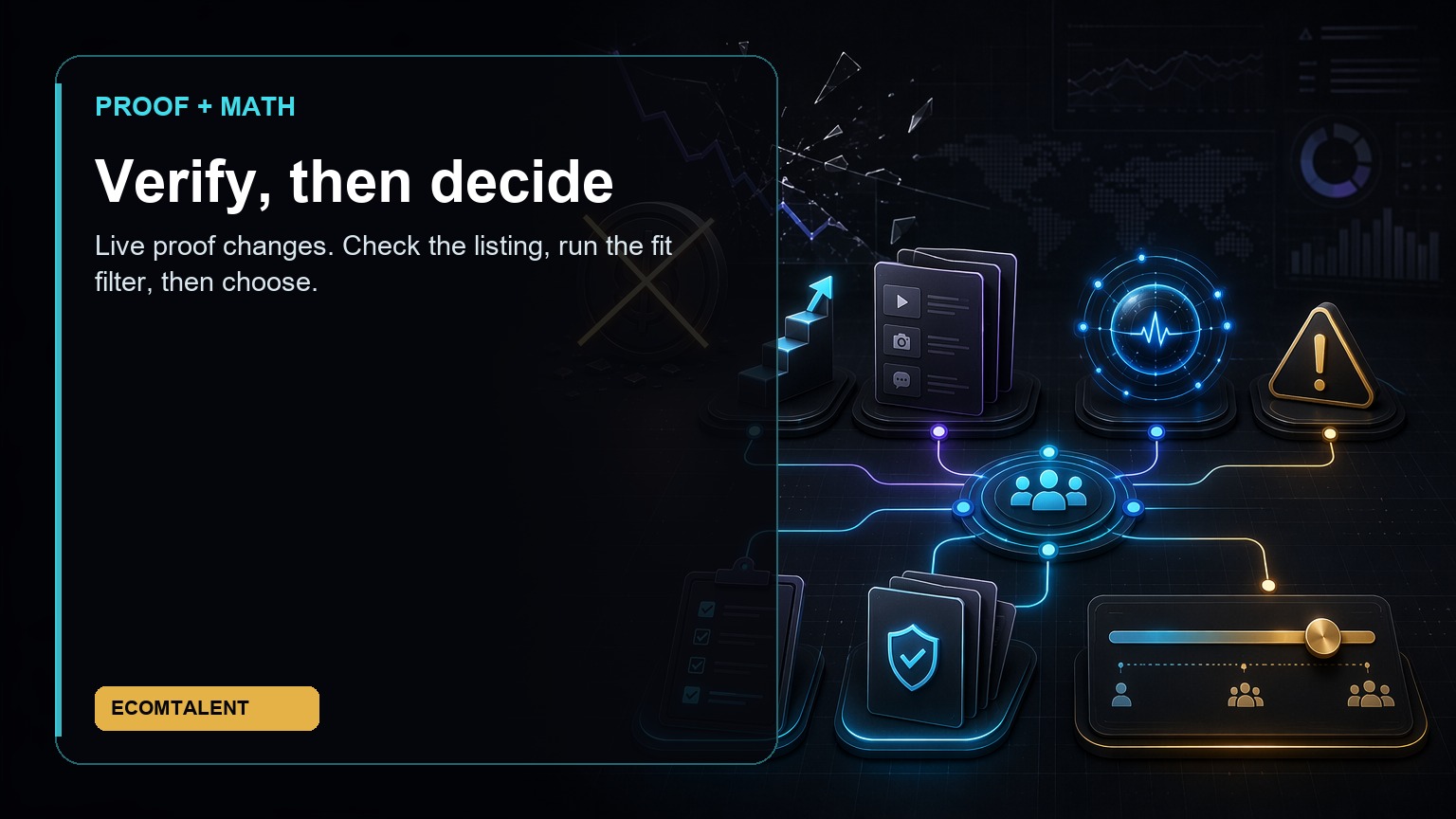
Let us be strict about what is verified and what is not, because that strictness is the entire point of this article.
Verified about EcomTalent at research time: 848 members. A 5.0 star rating. 284 reviews. Founder Karlo, handle @karlocreates, a solo operator who positions himself around scaling ecommerce brands with high-converting ads and teaching creators to do the same. The member tier is 97 dollars a month with no free trial and no operator refund guarantee. The training library is 20-plus hours of beginner-friendly ad-creative instruction. Verify every one of these on the live Whop listing before you buy, because numbers move.
Now the piece of proof most communities cannot show you. There is a second tier: brands pay 997 dollars a month, on a waitlist, to hire from the trained creator pool. Sit with that. The demand side is paying real money, ten times the member price, to access the creators being trained. That is not a testimonial. That is a market signal. When the buyers of the output are paying a premium and waiting in line, the output has value. No screenshot required.
Here is the buyer math, in dollars, no hype. The member tier is 97 dollars a month. Ninety-seven dollars. That is your input.
| The number | What it is | Status |
|---|---|---|
| $97 / month | Member tier cost, no free trial, no refund guarantee | Verified |
| $997 / month | Brand tier, waitlist, brands paying to hire the pool | Verified (demand proof) |
| 848 | Members at research time | Verified |
| 5.0 / 284 | Star rating / review count | Verified, check live listing |
| 20+ hours | Beginner ad-creative training | Verified |
| $75 to a few hundred / video | Reported flat UGC rate range, newer creators | Reported, varies widely |
| 6 to 12 months | How long a winning ad can run and pay on performance | Mechanism, not a guarantee |
What does 97 dollars have to return to be worth it? At the reported low end of flat UGC rates, one or two accepted videos in a month can cover the fee, and that is before any performance tail. But do not turn that into a promise, because I will not lie to you the way the screenshot did. Acceptance depends on your skill and your volume. The fee is fixed and certain. The income is a range and is earned. That asymmetry is the honest deal, and it beats "guaranteed ten grand," because that guarantee is the lie.
Where UGC loses, and what beats it
An honest breakdown names the competition and admits where it wins.
A regular job beats UGC on certainty. If you need a fixed number on the fifteenth and the first, and any variance will end you, a paycheck wins. UGC income is a range by nature. Ranges are not paychecks.
Selling reach beats UGC if you already have a large, engaged audience. A creator with a real following can command sponsorship money that a footage-only supplier cannot. If you have that audience, use it. UGC does not need followers, which is its strength for beginners, but a big audience is a different and sometimes bigger lever.
A free-then-paid grind can beat any course on raw cost if you have unlimited time and patience. You can learn UGC from free videos, film fifty flat-fee gigs, absorb every rejection yourself, and pay nothing but time. A structured community trades money for speed and for the brief-comes-to-you loop. If your time is worth nothing and your patience is infinite, the free path can win on dollars. For most people it loses on months.
EcomTalent is not the answer to every one of those. It is a performance-creative system for people who want the loop and the brand demand attached. If your situation matches a row above, be honest with yourself and pick that instead.
Where to be careful
Three genuine caveats. Read all three before you spend a dollar anywhere in this space, here or elsewhere.
- Revenue is not profit, and it never was. Every rate in this article is gross. Your phone, lighting, props, sample products, editing apps, and above all your hours come out first. A 300-dollar month with 20 hours of filming and 60 dollars of props is not a 300-dollar month. Track your costs from video one, or the number in your head will lie to you as badly as the screenshot did.
- Outliers are marketing, not forecasts. The eleven-thousand-dollar month exists for someone. It is not your baseline, your median, or your promise. Anyone selling you the outlier as the expectation is selling the lie this whole article exists to break. EcomTalent gives you a mechanism and real demand proof. It does not give you an income guarantee, and I am not giving you one on its behalf.
- Performance pay starts slow and rewards volume. The tail is the magic, but the tail begins at zero. Your first briefs may not convert. Your early ads may not win. Performance income compounds for the people who keep shipping through the flat part of the curve. If you need money this Friday, this is the wrong dial to turn first.
The 6-point checklist before you commit to any UGC path
- Can you name the pay model? Flat or performance. If you cannot say which one a program or gig uses, do not sign. That single word sets your entire ceiling.
- Is the demand side real? Are actual brands paying to be there, or is it just creators paying to learn from other creators? The 997-dollar brand waitlist is the kind of signal you want to see somewhere in the model.
- Can you verify the public numbers yourself? Members, rating, reviews, price. Open the live listing. Numbers move, and a program worth joining will survive you checking.
- Do you have the reps in you? Ten to fifty pieces of practice before you are sharp. If that number makes you flinch, the income range will disappoint you no matter what you join.
- Have you budgeted the true cost? The fee, plus gear, plus your hours. Compare against the reported income range honestly, not against the screenshot.
- Is this actually your vertical? EcomTalent is UGC and performance ad creative for ecommerce brands. It is not a dropshipping or a Shopify store-building mentorship. If you wanted to build a store, this is the wrong room, and that is a good thing to learn before paying, not after.
Check the live listing before you join. Confirm the current price, proof, and terms on Whop, then decide whether you will actually submit ads.
See EcomTalent on Whop ->The verdict, decided both ways
Buy in if you are ready to treat UGC as a craft, ship volume, and play the performance dial instead of praying for the flat-fee jackpot. At 97 dollars a month with a verifiable 5.0 across 284 reviews, a 848-member base, and a 997-dollar brand tier proving real demand, EcomTalent is a legitimate, structured on-ramp into performance ad creative, with the Ad Bounty loop delivering briefs to you instead of you begging for them. That is a fair trade of money for speed and access. The income is still a range, still earned, still dependent on your skill and reps. But the machine around it is real, and the demand side is paying to prove it.
Skip it if you need a guaranteed number, if you want influencer-style reach income, if you refuse to film your first fifty practice pieces, or if you already have unlimited time to grind the free path. And skip anything, here or anywhere, that shows you a screenshot and calls it a plan.
The honest answer to "how much do UGC creators make" is the one the screenshot will never give you. It is a range. A wide one. Set by your skill, your volume, and whether you get paid once or paid for months. Turn those dials. Ignore the highlight reel. And build a number that is yours, that repeats, and that no one has to screenshot for you to believe it.
FAQ
How much do UGC creators make per video?
It varies widely. Reported flat rates for newer creators commonly fall in a range of roughly seventy-five to a few hundred dollars per video, depending on niche, quality, and usage rights, with experienced creators reporting higher. Treat all of these as reported and variable, never as a guaranteed rate. Performance pay works differently: instead of a per-video price, you earn a percentage of the sales your ad drives, potentially for the six to twelve months an ad runs.
Can you really make money with no followers?
Yes, because UGC sells footage, not reach. Brands buy your ad creative and run it as paid ads to their own audience, so your follower count is not the product. Your ability to make footage that sells is the product. That is why skill, not audience size, is the real income variable.
Is UGC income reliable enough to quit my job?
Not at the start. UGC income is a range, not a paycheck, and performance pay in particular starts slow and rewards volume over time. Treat it as a skill you build alongside stability, and let the performance tail compound before you count on it. Revenue is also not profit, so track your real costs before making any life decision on the number.
What is the Ad Bounty loop in plain terms?
It is the performance-pay model turned into a system. A pre-vetted ecom brand posts a brief, you create the ad, the brand tests it in market, and if it drives sales you earn a percentage of every sale it generates, sometimes across a six to twelve month run. Top performers then get hired directly by brands on monthly retainers. It replaces cold outreach and the flat-fee ceiling with briefs that come to you and income that has a tail.
Is EcomTalent a dropshipping or Shopify course?
No. It is UGC and performance ad creative for ecommerce brands. You are learning to make ads that sell, not to build a store or source products. If store-building is your goal, this is the wrong program, and it is better to know that before you pay.
How do I verify EcomTalent's numbers before joining?
Open the live Whop listing. At research time it showed 848 members, a 5.0 rating across 284 reviews, a 97-dollar member tier with no free trial, and a 997-dollar brand tier on a waitlist. Those numbers move over time, so confirm the current figures yourself on the listing before you decide. A program worth joining will hold up to that check.