
Is UGC still worth it in 2026? You are asking because the room got loud. Two years ago you saw the pitch: film yourself holding a product, get paid, quit the day job. So you joined. So did everyone. Now your DMs sit unread, your rates keep sliding, and every third person on your feed calls themselves a UGC creator. The room is packed. The air is thin. And a voice keeps whispering that you showed up late to a party that already ended.
Here is the honest read, and it is not the one the doom-posters sell you. The crowded room is real. The dead market is a myth. The door most people rushed through leads to a room that is oversupplied. There is a second door. Fewer people find it. Brands are still standing on the other side of it, wallets open, waiting.
What UGC actually is, without the fluff
UGC means user-generated content: video and photo ad creative that looks like a real person made it, not a studio. A creator films a product in a kitchen, a car, a bathroom mirror. A brand runs that footage as a paid ad. The point was never art. The point is performance. The ad exists to make a stranger stop scrolling and buy.
That last sentence is the whole game, and most people who joined the UGC gold rush never read it. They learned to film. They never learned to sell. They can shoot a clean fifteen-second clip about a water bottle. They cannot tell you why one hook beats another, what a thumb-stop rate is, or why the brand killed their video after two days. They made content. They did not make ads.
The distinction sounds small. It is the entire difference between the crowded room and the second door.
Who this is for, and who should leave right now
Let me push the wrong buyer out before you spend a dollar. Read these and be honest.
Leave if you want passive income. This is skilled work. You will study, film, get rejected, and iterate. Leave if you refuse to learn the ad side and only want to be "on camera." The market already has too many of you, and that is the plain truth. Leave if you need guaranteed money next week; nobody honest can promise that, and the platform default refund window is the only safety net here. Leave if you think a $97 course is a magic key. It is a room full of training and a mechanism, not a lottery ticket.
Stay if you treat this like a craft. Stay if you already sense that the winners understand why an ad works, not just how to hold a bottle. Stay if you want the boring, durable skill: writing hooks, reading performance, making creative that moves sales. Stay if you would rather be one of a few hundred people learning to make ads than one of a hundred thousand people "doing UGC." That instinct is correct, and the rest of this piece is the proof.
Check the live listing before you join. Confirm the current price, proof, and terms on Whop, then decide whether you will actually submit ads.
See EcomTalent on Whop ->The costly belief that is bleeding your confidence

Here is the lie, and it is expensive: UGC is oversaturated and dead.
You believe it because the evidence looks overwhelming. Rates dropped. Competition exploded. Every platform is wall-to-wall with people announcing their UGC portfolios. If you measure the market by counting faces holding products, yes, the supply is brutal and the price is falling. That measurement is real. That measurement is also the wrong measurement.
Because "UGC" is not one market. It is two, wearing one name.
Market one is generic content. Pretty footage. A person, a product, a caption. It is a commodity. When a thing becomes a commodity, price collapses toward the cost of producing it, and the cost of producing a phone video is nearly nothing. That market is crowded. That market is deflating. The doom-posters describe this market accurately and then, quietly, tell you it is the only one.
Market two is performance creative. Ads that a brand can pour real ad spend behind and profit. This market is not measured by how nice the video looks. It is measured by whether the video sells. A brand does not care that ten thousand people can film. A brand cares that almost none of those ten thousand can make an ad that returns more money than it costs to run. That skill is not oversupplied. That skill is rare, and rare things do not deflate. They command a premium.
Install the true belief and do not let go of it: generic UGC is crowded, but demand shifted to creators who understand ads and performance. Skill plus distribution still wins. The market did not die. It moved through the second door, and it left the tourists standing in the packed room wondering where everyone went.
The number that settles the argument
Beliefs are cheap. Let me put a number on the table.
Inside EcomTalent there are two tiers. Members pay $97 per month to train and to work. Brands pay $997 per month, on a waitlist, to hire from that trained pool. Read that second sentence again. Brands are paying nearly a thousand dollars a month for access to performance creators. Not for content. For access to people who can make ads that work.
That is the whole thesis in one live signal. If UGC were dead, the demand side would be empty and the brand tier would not exist. Instead there is a waitlist on it. A dead market does not keep a paid, waitlisted queue of buyers. A shifted market does. The brands voted with the most honest instrument there is, their own money, and they voted for the second door.
One caveat, stated plainly because this doctrine demands it: $997 per month is the brand-side price and a demand signal, not a promise of your earnings. It proves buyers exist and pay a premium. It does not tell you what you personally will make. What you make depends on your skill, your reps, and whether your ads perform. Anyone who converts that brand-tier number into a guaranteed creator income is lying to you.
The mechanism: the Ad Bounty loop
Use the same filter before you join. Check the live Whop listing, confirm the current price and proof, then decide whether you will actually submit ads.
Check EcomTalent on Whop ->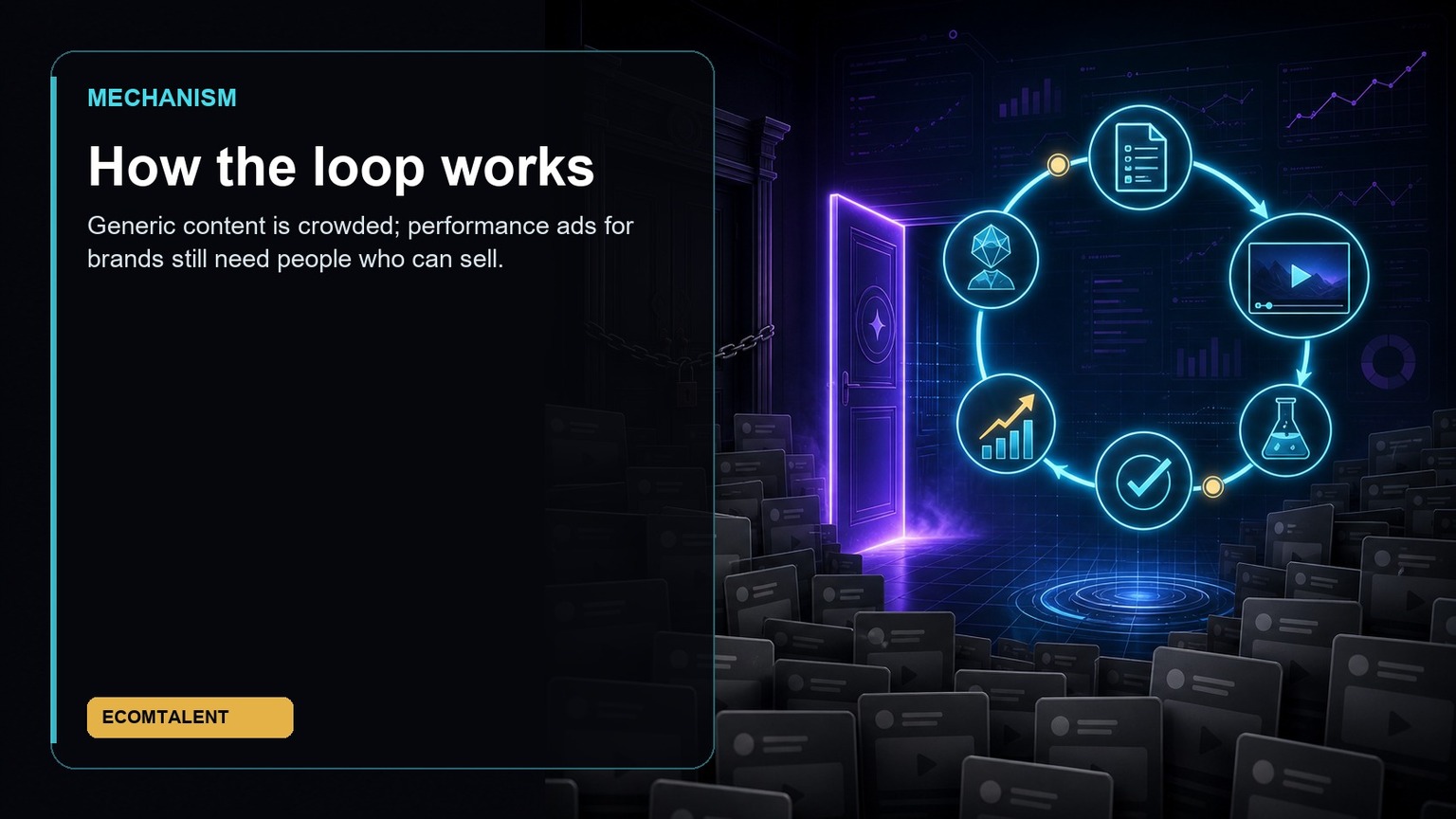
A belief needs a mechanism you cannot un-see. Inside EcomTalent the mechanism is the Ad Bounty loop, and it is the cleanest illustration of the second door I can give you. Here is the loop, numbered, no fluff.
- A pre-vetted ecom brand posts a brief. Not a random gig. A real brand with a real product and a real problem, filtered before it reaches you.
- A member creates an ad against that brief. You apply the training. You make the creative.
- The brand tests it in market. Real spend, real audience, real numbers. The ad either moves sales or it does not.
- If the ad drives sales, the member earns a percentage of every sale it generates. Not a flat fee that ends the moment you deliver. A percentage, paid for as long as the ad keeps performing.
- Top performers get hired directly by brands on monthly retainers. The loop stops being a gig and becomes a client.
Sit with step four, because it is where the flat-fee ceiling gets shattered. The old UGC model paid you once. Film it, send it, get your fee, chase the next gig forever. Your income was a treadmill: stop running, stop earning. The bounty model ties your pay to performance over time. An ad that keeps selling keeps paying. You are no longer paid for footage. You are paid for results, and results compound.
This is why the "skill plus distribution" belief matters in practice. The training, reported as 20+ hours of beginner-friendly ad-creative instruction, is the skill. The Ad Bounty loop is the distribution: the door that connects a trained creator to a paying brand and a market test. Skill without distribution is a talented person nobody hires. Distribution without skill is an opportunity you fumble. The loop only pays the people who bring both.
Proof and buyer math in your real currency
Let me lay the verified facts side by side and then do the arithmetic in dollars, the only currency that matters when you are deciding.
| Fact | Number | What it signals |
|---|---|---|
| Members | 848 | Real, active community, not a ghost town |
| Rating | 5.0 stars | Members who joined mostly do not regret it |
| Reviews | 284 | The rating rests on volume, not three friends |
| Member price | $97 / month | Your cost to enter the second door |
| Brand tier | $997 / month, waitlist | Demand side is live and paying a premium |
| Training | 20+ hours | The skill layer, aimed at the ad side |
Verify these on the Whop listing before you join, because live numbers move. As of research time, that is the picture: 848 members, 5.0 stars across 284 reviews. A 5.0 across 284 reviews is not a fluke. It is a lot of people who paid $97 and, on balance, felt they got their money back and then some.
Now the buyer math, and I will only use the one price I can state as fact, $97, and clearly labeled industry ranges for everything else.
Your cost to test this is $97 for one month. That is the entire downside of finding out whether the second door is real for you, minus whatever the platform default refund window covers. Against that, consider the reported and widely varying industry ranges for performance creators: rates for skilled UGC ad creative commonly run anywhere from a modest per-video fee for beginners to several hundred dollars or more per deliverable for proven performers, and retainer arrangements vary widely by brand and by results. I am not promising you land any of that. I am showing you the shape of the trade. You are risking one $97 month against a skill and a distribution channel that, if they work for you, pay in units far larger than $97. That is an asymmetric bet. The downside is capped and small. The upside depends on you and is not capped.
Compare that to the old flat-fee treadmill. There, your best month is your busiest month, and it ends when you stop filming. Here, step four means a single winning ad can pay across many months. The math is not close on structure. Whether you can execute it is the open question, and honesty requires me to leave it open.
Where it loses, and what beats it
No honest review pretends its subject wins everywhere. Here is where EcomTalent loses.
If you want a personal one-on-one mentor, a big-name coach texting you edits, this is not that. Karlo runs this as a solo operator, handle @karlocreates, and the model is community plus training plus the bounty loop, not private hand-holding. A premium one-on-one coaching program will beat it on personal attention, and it will cost you many multiples of $97 to get that attention.
If you already have brand clients and a booked calendar, a community that teaches acquisition may add little. You are past the problem it solves. A pure high-end mastermind of your peers might serve you better.
If you want dropshipping or Shopify store-building, look elsewhere entirely. This is critical and I want zero confusion: EcomTalent is UGC and performance ad creative for ecommerce brands. It is not a dropshipping course. It is not a store-building mentorship. If your goal is to run your own store, a store-building program beats this because this is not trying to be that at all.
Where to be careful
Three genuine caveats, because a fair guide arms you against its own subject.
- The bounty loop pays on performance, and performance is not guaranteed. Steps three and four hinge on your ad actually driving sales. If your creative does not perform, you do not earn the percentage. This rewards skill and reps. It does not reward showing up. Go in expecting to be bad before you are good.
- $97 per month recurs. It is not a one-time fee. If you join, get busy, and forget, it keeps billing. There is no free trial and no operator guarantee beyond the Whop platform default, so set a calendar reminder and decide each month whether you are using it. Treat it like a gym membership: worthless if you never walk in.
- The community is 848 members and growing, which means the Ad Bounty briefs are shared, not infinite. More members can mean more competition for briefs inside the community too. The trained-creator edge is real, but it is not a private monopoly. Your results still depend on being among the better creators in the room, not merely being in it.
The checklist that de-risks your decision
Run this before you pay. If you answer yes down the list, the odds tilt your way. If you stall on the first three, keep your $97.
- Am I willing to learn the ad side, not just film myself? (This is the second door. Non-negotiable.)
- Can I commit real hours to the 20+ hours of training and then to reps after?
- Can I absorb rejection and iterate without quitting after two failed ads?
- Have I checked the live Whop listing for current member count, rating, and price?
- Do I understand $97 recurs monthly, with no free trial and only the platform default refund window?
- Am I clear this is UGC performance creative, not dropshipping or store-building?
- Do I have a phone, decent light, and the willingness to shoot? (The gear bar is low. The effort bar is not.)
- Will I actually log in weekly, engage the briefs, and use the bounty loop?
Check the live listing before you join. Confirm the current price, proof, and terms on Whop, then decide whether you will actually submit ads.
See EcomTalent on Whop ->The verdict, decided both ways
Is UGC worth it in 2026? Wrong framing. Generic UGC, the crowded room, is a fading trade, and if that is all you plan to do, save your money and your evenings. The right question is whether performance creative is worth it, and there the answer is yes, because the demand shifted through the second door and the brands are still there paying $997 a month to reach the people who walked through it.
Buy if you are on the fence, you accept that the ad side is the real skill, and you want a structured way in: 20+ hours of training, a community of 848 rated 5.0, and the Ad Bounty loop that ties your pay to performance instead of a flat fee. At $97 for one month, the cost of finding out is small and the downside is capped. That is a rational bet for the right person.
Skip if you want passive income, refuse to learn ads, need guaranteed money now, want one-on-one coaching, or are actually looking for dropshipping. None of those wishes match what this is, and forcing the fit wastes your $97 and your time.
The room is crowded. The door is not. Skill plus distribution still wins, and the winners are the ones who stopped counting the crowd and started counting the buyers on the other side.
FAQ
Is UGC oversaturated in 2026? Generic UGC is crowded, yes. Performance creative is not. The people who only film are competing on price in a packed room. The people who understand ads, hooks, and what makes a brand profit are still scarce, and scarcity holds price. The saturation is real in one lane and largely absent in the other.
Can beginners still make money with UGC? They can, but not by staying beginners. The training is described as beginner-friendly and runs 20+ hours, and the Ad Bounty loop gives beginners a path to real briefs. Earnings depend on performance and vary widely; nobody honest guarantees a number. Expect a learning curve before results.
What makes EcomTalent different from a UGC course? A course sells you videos and ends. EcomTalent pairs training with a mechanism, the Ad Bounty loop, where pre-vetted brands post briefs, members create ads, brands test them, and creators earn a percentage of the sales the ad drives for as long as it keeps performing, with top performers hired on retainers. It is skill plus distribution, not just skill.
How much does EcomTalent cost? The member tier is $97 per month with no free trial. The brand tier is $997 per month with a waitlist, which is the demand-side signal, not your earnings. Verify current pricing on the Whop listing before joining.
Is EcomTalent a dropshipping or Shopify program? No. It is UGC and performance ad creative for ecommerce brands. If you want to build your own store or run dropshipping, this is the wrong program and a store-building course will serve you better.
Who runs EcomTalent? Karlo, handle @karlocreates, a solo operator whose stated focus is scaling ecom brands with high-converting ads and showing others how to do the same. You can find him on Instagram, X, and YouTube under that handle. Do your own diligence and check the current listing before you decide.