
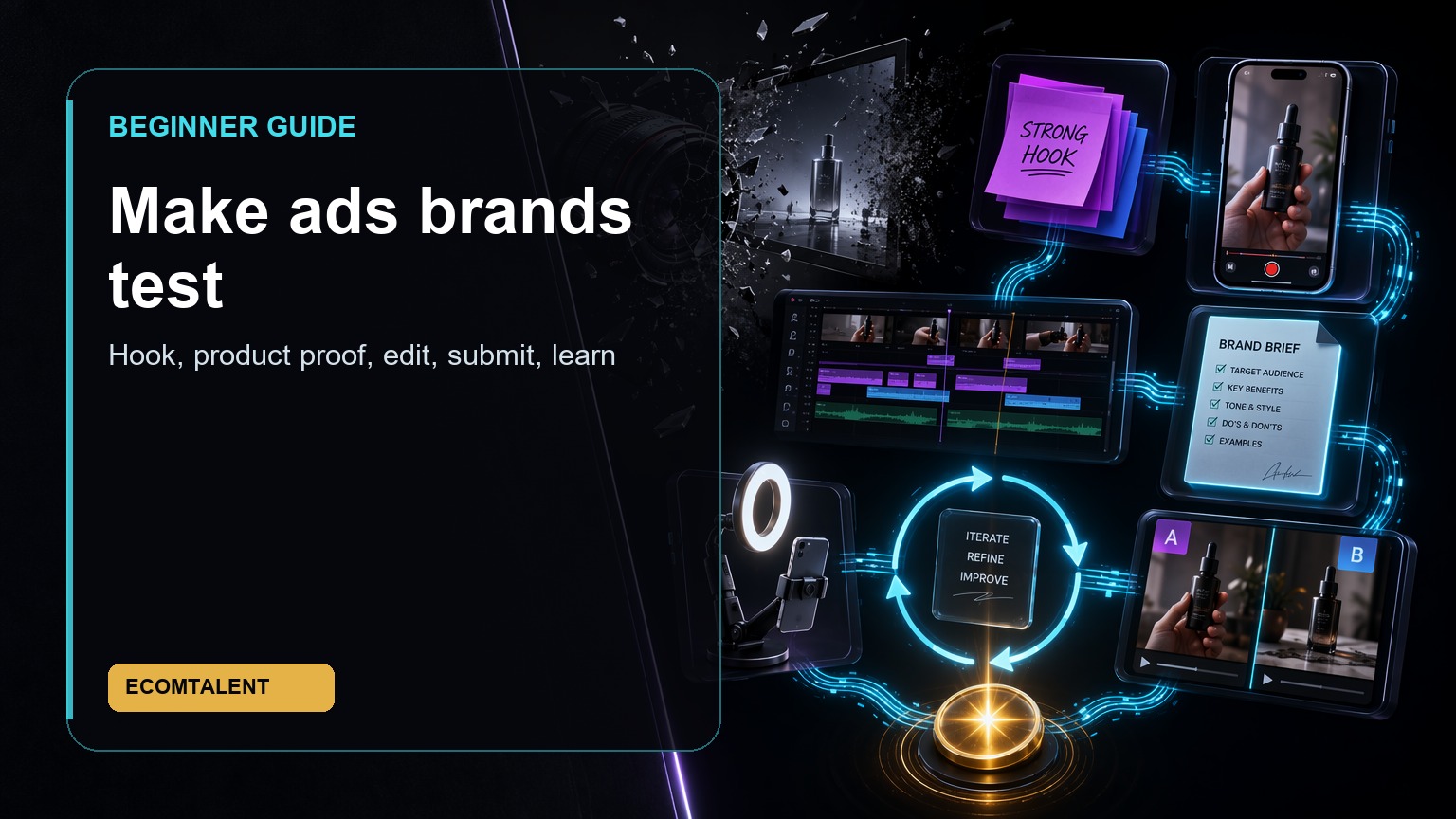
Learning how to make ads for ecommerce brands starts the moment you stop waiting. Right now you are scrolling a feed, watching a fifteen-second clip of someone holding a bottle of face serum in a messy kitchen, shot on a phone, lit by a window. It stops your thumb. It sells. And somewhere a brand is paying the person who filmed it, not the agency, not the studio, not the film-school graduate. The person with the phone. You have that phone. What you do not have, yet, is the framework. That is the only gap, and this guide closes it.
You have watched a hundred of these ads without knowing you were watching the highest-leverage skill in ecommerce. You thought they were "content." They are engineered. Once you see the machine under the hood, you cannot unsee it, and you start building your own.
What an ecommerce ad actually is, no fluff
An ecommerce ad is a short video that makes a stranger believe a product solves a specific problem, fast enough that they do not scroll away. That is the whole job. It runs on Meta, on TikTok, on YouTube Shorts, in the feed and the reel and the story. Most of the ones that work today are UGC: user-generated content. They look like a real person talking to a camera, not a polished commercial.
The look is casual on purpose. A phone. A window. A kitchen counter. Because the feed is a river of real people, and an ad that looks like a real person swims. An ad that looks like a Super Bowl spot gets flagged as an ad and flicked away. The rough edge is the strategy, not a compromise.
So the craft is not cinematography. The craft is hook, angle, script, and structure. A hook that stops the scroll. An angle that frames why this product, for this person, right now. A script that carries belief from the first word to the call to action. And a UGC structure the brand can test against the ad they are already running. That is the entire skill. Learn those four and the camera becomes the least important thing in the room.
Who this is for, and who should close the tab
This is for the beginner who wants a real skill, not a lottery ticket. You have a phone. You can talk to a camera or point it at your hands. You are willing to write a script before you hit record, film five versions, and let a brand tell you which one sold. If that is you, keep reading. You are who this works for.
It is also for the introvert who never wants their face online. Good news. A large share of ecom ads are shot over the shoulder, hands only, product only, voiceover on top. You can build a whole skill set and never appear once.
Now, who should close the tab. If you want passive income while you sleep, this is not it. Making ads is work, and the good ones come from reps. If you refuse to write, refuse to film ugly first drafts, or need a guarantee before you start, leave. This rewards the person who ships, not the person who plans forever. And if you are looking for a dropshipping course or a Shopify store-building mentorship, this is a different craft entirely: you are learning to make the creative that sells products, not to run the store.
Check the live listing before you join. Confirm the current price, proof, and terms on Whop, then decide whether you will actually submit ads.
See EcomTalent on Whop ->The costly belief that keeps you broke
Here is the lie, and it has cost more beginners more years than any other: you need a studio, a fancy camera, an agency, or to be on-camera to make ecommerce ads.
You believe it because every gatekeeper profits from you believing it. The camera store wants the expensive-body sale. The agency wants the retainer. The "creator" selling lighting kits wants the kit money. They all whisper the same thing: you are not ready, you need gear, you need a team, you need to be beautiful and bold on camera. So you wait. You save for gear you will never fully use, and talk yourself out of it before you film a single second.
Break it now. The single most reported pattern in short-form advertising is this: the first few seconds decide most of an ad's fate. The hook does the heavy lifting. Not the resolution. Not the color grade. Not the lens. A blurry phone clip with a hook that names the viewer's exact problem will out-sell a cinematic masterpiece that opens slow, every time the market gets to vote. The money lives in the first three seconds, and the first three seconds are free.
Sit with that. The thing you cannot afford, the studio and the crew, does not touch the part that decides the outcome. The part that does, the hook and the angle and the words, costs nothing but reps. The gate was never locked. Someone just told you it was.
So the true belief, the one to install and never let go: the craft is hook, angle, script, and a UGC structure brands test. A phone and the right framework is enough to start. Everything after this sentence is how.
The mechanism: how to build a testable ad, step by step
Use the same filter before you join. Check the live Whop listing, confirm the current price and proof, then decide whether you will actually submit ads.
Check EcomTalent on Whop ->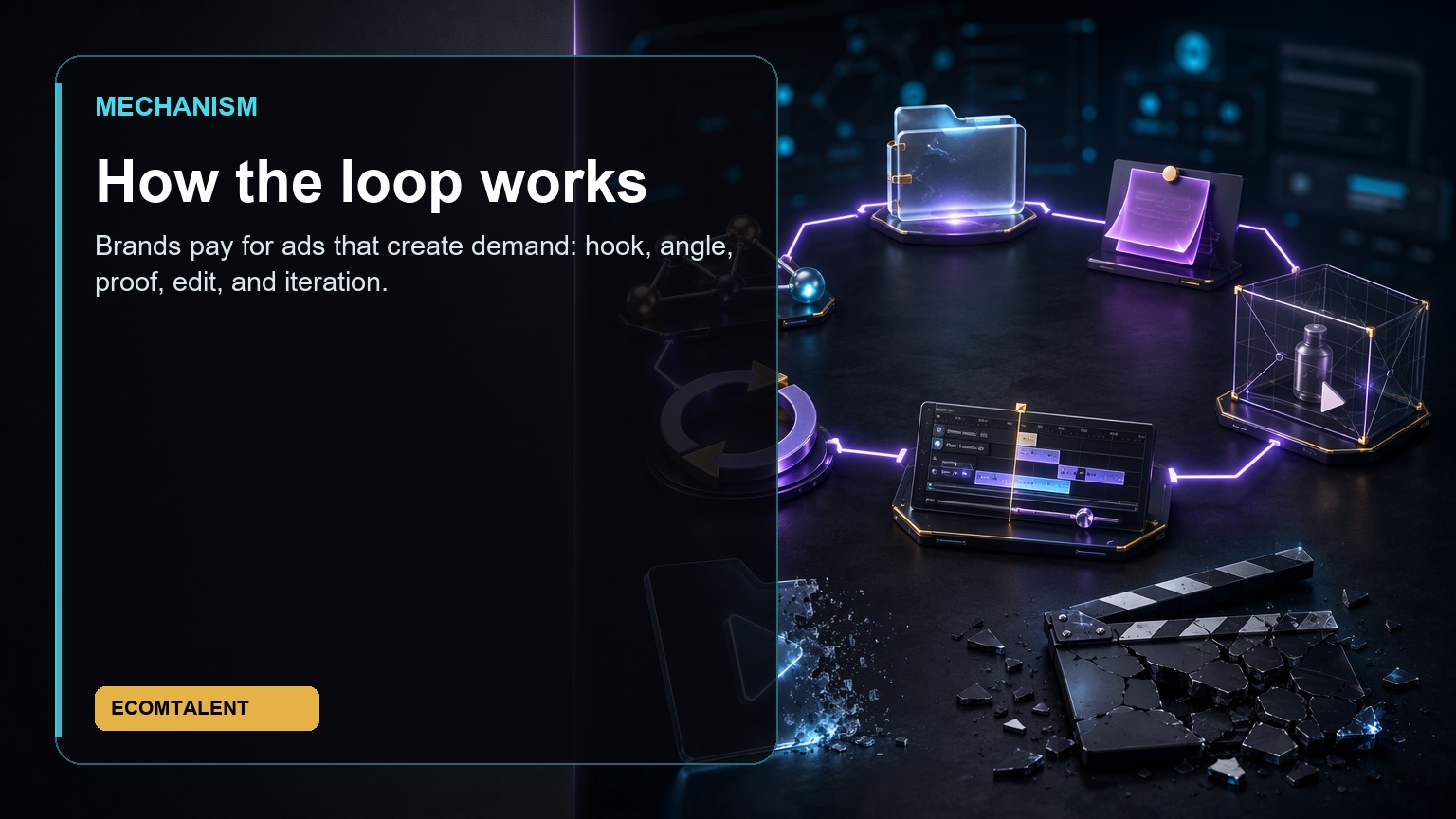
A testable ad is one a brand can drop into their ad account and measure against what they already run. Beginners make "content." Professionals make testable ads. The difference is structure. Here is the loop, the way the good ones are built.
Step 1: Pick one angle, not the product
The product has ten reasons to buy. An ad has one. The angle is the single problem-to-payoff line the whole video rides. For a sleep supplement, one angle is "you wake up at 3am and cannot get back down." Another is "you hate feeling groggy from the other stuff." Same product. Different ad. Different buyer. You write one ad per angle, because an ad that argues five things convinces nobody. Pick the one pain and own it for fifteen seconds.
Step 2: Write the hook first, and write ten of them
The hook is the first line and the first frame. It is the whole game. Write ten before you fall in love with one. Hooks that reliably stop scrolls tend to fall into patterns:
- The callout: "If you're over 30 and still breaking out, watch this."
- The problem-first: "I could not figure out why my hair kept falling out."
- The result-first: "This is what three weeks did to my under-eyes."
- The contrarian: "Stop buying expensive moisturizer. Here's why."
- The demonstration: hands already doing the thing, no intro, mid-action from frame one.
Front-load the strongest word. Name the viewer. Make a promise or spark a question in the first breath. If the hook is weak, nothing downstream matters, because nobody sees downstream. Write the hook first because it is the ad.
Step 3: Script the body as a belief ladder
After the hook, the script carries the viewer up a ladder of belief. Problem, then agitation, then the product as the turn, then proof, then the offer. Keep sentences short. Talk like a person telling a friend, not a brand reading a brochure. A simple, reliable body structure:
- Name the problem the way the viewer says it in their own head.
- Twist the knife gently: what it costs them, how long it has dragged on.
- Introduce the product as the thing that changed it, casually, mid-story.
- Show proof: the texture, the before, the how-it-works, the real moment.
- Call to action: one clear next step, one link, one reason to go now.
Step 4: Shoot ugly, shoot lots, shoot in pieces
Now the camera, the part you feared, the part that matters least. Film by the window; daylight is the best free light on earth. Wipe the lens. Prop the phone against books. Record the hook five different ways. Record B-roll: the product opening, the hands using it, the label, the result. You are not filming a movie. You are filming Lego bricks you snap together in edits. Shoot more than you think you need, because you cannot edit footage you never shot.
Step 5: Edit for retention, cut every dead second
Open on the hook, no logo intro, no slow build, no "hey guys." Cut every pause. Add captions, because most of the feed watches on mute. Keep it tight, usually fifteen to thirty seconds for a first test. The rule is simple and brutal: if a second does not earn attention, delete it. Retention is the ballgame. A dead second is a scroll.
Step 6: Make variations, because one ad is not a test
Here is the professional move beginners skip. You do not deliver one ad. You deliver the same body with three different hooks. Or three different opening frames. The brand tests them against each other and against their current best ad, and the market picks the winner. You are not guessing which hook wins. You are building the experiment that finds out. That is what "testable" means, and why brands pay for it.
The Ad Bounty loop: where the reps turn into money
You can learn all six steps alone, on free videos, filming for imaginary brands. Slow, and you never find out if your ad actually sold anything. The market never votes.
The faster path is a structure where real brands hand you real briefs and the market grades your work in dollars. That is the model behind EcomTalent, the community run by Karlo (handle @karlocreates), a solo operator whose bio is "scaling ecom brands with high-converting ads, showing you how to do the same." The engine inside it is the Ad Bounty loop, and it works like this:
- A pre-vetted ecommerce brand posts a brief inside the community.
- A member creates an ad against that brief, using the exact craft above.
- The brand tests the ad in market, in a live ad account, with real spend.
- If the ad drives sales, the member earns a percentage of every sale it generates. Winning ads are reported to run for months, which means one good ad can pay across months, not once.
- Top performers get hired directly by brands on monthly retainers.
Read step four again. A percentage of every sale, on an ad that, in reported cases, keeps running for months. That is the difference between the flat-fee ceiling, where you get paid once per video and start from zero every morning, and a structure where your best work keeps paying while you make the next one. The flat fee caps you. The bounty compounds you. That is the villain this model was built to kill.
To learn the craft first, EcomTalent includes 20+ hours of beginner-friendly ad-creative training, which is the point: you are not thrown at a brief on day one, you are taught hook, angle, script, and structure, then handed live briefs to practice on. And the demand side is real. Brands pay a separate tier, reported at $997/month on a waitlist, specifically to hire from the trained creator pool. When buyers line up and pay to access the people with the skill, the skill has a market.
Proof, and the buyer math in your currency
Verified numbers, framed as evidence, not as a promise anyone can make you. At research time, the EcomTalent listing on Whop showed 848 members, a 5.0 star rating, and 284 reviews. Verify the current numbers yourself on the listing before you decide; live communities move. But a 5.0 across 284 reviews is not an accident, and not a handful of friends.
Now the math in dollars, your real currency. Member access is $97/month. Ninety-seven dollars. No free trial, no operator refund guarantee beyond the Whop platform default, so go in knowing that. What does ninety-seven have to return to be worth it?
The UGC market pays creators per-video rates that vary widely and are commonly reported to climb with skill and results; treat any specific figure you see online as a reported range, not a guarantee, because rates depend on the brand, the deliverable, and performance. Here is the honest arithmetic:
| What you pay | What it takes to break even | What the loop can add on top |
|---|---|---|
| $97/month membership | One paid deliverable at a commonly-reported UGC rate can cover it, though rates vary widely and nothing is guaranteed | Ad Bounty: a percentage of every sale a winning ad drives, on ads reported to keep running for months |
| No free trial | You are betting the $97 on your own reps; the training is 20+ hours to shorten the odds | Retainers: top performers reported to get hired directly by brands monthly |
The table is not a promise. It is the shape of the bet. You risk ninety-seven dollars a month against a skill that, if it lands one paid deliverable, pays for itself, and if it lands one winning ad through the bounty loop, pays across months. The downside is capped at what you can see. The upside depends on your reps. Anyone who promises you more than that is selling the old lie in a new box.
Where it loses: the honest comparison
No single path wins on every axis. Here is where EcomTalent is not the answer.
| Path | Best for | Where it beats EcomTalent | Where it loses |
|---|---|---|---|
| Free YouTube plus practicing solo | Zero budget, self-directed learners | Costs nothing | No live briefs, no market voting on your work, no bounty upside, slow feedback |
| Freelance marketplaces (Upwork, Fiverr, UGC platforms) | Landing one-off paid gigs fast | Direct clients today, no monthly fee | Flat fees, race to the bottom on price, no percentage-of-sales, you find clients alone |
| High-ticket agency mentorships | People building a full agency | Broader business systems | Often far more than $97/month, heavier, less focused on the pure creative rep |
| EcomTalent ($97/mo) | Beginners who want the craft plus live brand briefs | Training plus Ad Bounty loop plus retainer path in one place | Monthly fee, no free trial, upside depends on your reps and performance |
If you have zero dollars, start free today. The trade is speed, structure, and the bounty upside, which is what the ninety-seven buys. If you already have steady direct clients paying you well, you may not need a community at all. Honest is honest.
Where to be careful
Three real caveats, because a guide that only sells is a guide you cannot trust.
- There is no free trial and no operator refund guarantee beyond the Whop platform default. You are paying $97 before you see the inside. Budget it as a real cost you might not recover, not a risk-free peek.
- Bounty earnings depend on performance, and performance is not promised. An ad only earns a percentage of sales if it actually drives sales in a live market. Some briefs will go to other members. Your first ads may lose. That is the craft, not a defect, but go in expecting reps before results.
- Communities change. The 848 members, 5.0 rating, and 284 reviews were live at research time. Member count, active brands, and the volume of open briefs can all shift. Verify the current listing before you pay, and judge it on what it is the day you look.
The checklist that de-risks your decision
Before you spend a dollar or hit record, run this list.
- Can you commit to filming and scripting at least a few ads a week? If no, wait until you can.
- Do you have a phone that shoots clear video and a window? That is the entire kit.
- Have you written ten hooks for a single product, just to prove you can? Do it free, today, before paying anyone.
- Can you afford $97 as a cost you might not recover this month? Only join if yes.
- Are you clear this is UGC ad creative, not a dropshipping or store-building course? Match the tool to the goal.
- Will you judge yourself on reps shipped, not results guaranteed, for the first 30 days?
Check the live listing before you join. Confirm the current price, proof, and terms on Whop, then decide whether you will actually submit ads.
See EcomTalent on Whop ->The verdict, decided both ways
Buy it if you are a beginner who has accepted the true belief: the craft is hook, angle, script, and structure, and a phone is enough to start. If you will ship ugly first drafts, write before you film, and treat $97 as tuition on a real skill with a live path to paid briefs and a bounty loop that can pay across months, this is a strong, focused, well-reviewed place to start. The demand side paying $997 to hire the pool tells you the skill has buyers.
Skip it if you want passive income, need a guarantee, refuse to appear on camera and also refuse to learn voiceover and hands-only formats, or you already have steady direct clients paying you well. Skip it too if $97 is money you cannot afford to lose this month; go film for free brands off YouTube tutorials first, then come back when the reps prove you like the work.
Either way, the lie dies today. You never needed the studio. You never needed the crew. You never needed your face if you did not want it there. You needed the framework, and now you have the shape of it: the first few seconds decide most of the ad, the hook is free, and the reps are yours to take. The phone is already in your hand. Point it at a problem, and start.
FAQ
Do I need to show my face to make ecommerce ads?
No. A large share of ecom ads are hands-only, product-only, or voiceover-driven. You can build the entire skill, hook, angle, script, structure, and never appear on camera. Faceless UGC is a real and common format brands test.
How much can I earn making ads for ecommerce brands?
It varies widely and nothing is guaranteed. Per-video UGC rates are commonly reported in ranges that climb with skill and results. Inside a model like EcomTalent's Ad Bounty loop, a winning ad can earn a percentage of every sale it drives, and some ads are reported to keep running for months, but earnings depend entirely on performance.
Is EcomTalent a dropshipping or Shopify course?
No. It is a UGC and performance ad-creative community. You learn to make the creative that sells products for ecommerce brands, not to build or run a store. If your goal is store-building or dropshipping, this is the wrong tool; if your goal is the ad craft, it is the right one.
What does EcomTalent cost, and is there a trial?
Member access is $97/month with no free trial and no operator refund guarantee beyond the Whop platform default. A separate brand tier, reported at $997/month on a waitlist, is where brands pay to hire from the trained creator pool. Verify current pricing and numbers on the live listing before joining.