
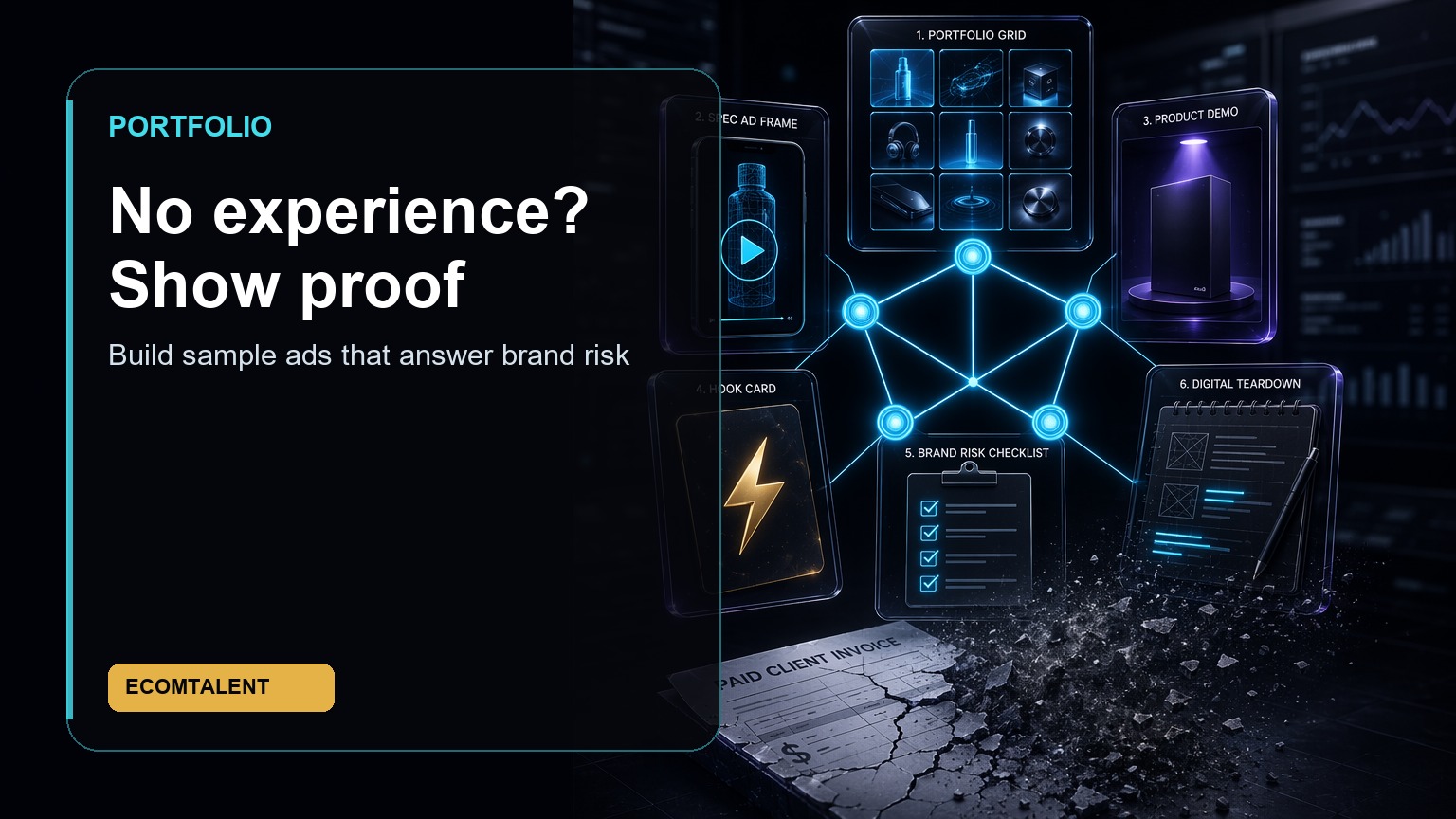
Building a UGC portfolio with no experience feels like being asked to show up to your first job with ten years on the resume. You open the blank Google Doc. You have no clients. No logos. No "as seen on." Just a phone, a ring light you bought at 11pm, and a cursor blinking at you like it knows you are stalling. So you scroll another creator's page instead. Sixty thousand followers. Products you have never touched. And a quiet voice says the thing that stops most people before they ever start: everyone else already has proof, and you have nothing to show.
That voice is wrong. Not softly wrong. Wrong in a way that costs you months.
This guide is for the person with zero clients who wants a concrete, do-it-this-week path from nothing to a portfolio a brand takes seriously. Not theory. A sequence. By the end you will know exactly what to film, how to make it look like real work, and how to get each piece sharper than the last.
What UGC actually is, in plain words
UGC stands for user-generated content. In the money sense, it means short, native-looking video ads that a brand runs as paid advertising. You are not a Hollywood editor. You are the person holding the product, talking to the camera like a friend who found something worth telling people about. The brand pays for the footage, or pays you a cut when the footage sells.
Notice what UGC is not. It is not building a Shopify store. It is not dropshipping. It is not chasing a follower count so brands slide into your DMs. Those are different games with different rules. UGC is ad creative. The only thing that matters is whether the video makes a stranger stop scrolling and buy. Your follower count is irrelevant. Your camera is a phone. Your studio is a kitchen counter with decent window light.
Which is exactly why it is the fastest creative skill for a beginner to monetize. The bar is not "be famous." The bar is "make an ad that works."
Who this is for, and who should close the tab
This is for you if you are starting cold. No clients, no reel, no idea what a "hook" is yet, but you can hold a phone steady and you are willing to film the same fifteen seconds eight times to get it right. It is for the person who would rather build a skill than buy a lottery ticket.
Close the tab if you want passive income. UGC is active. You make the video, you get paid for the video. It is for the person who wants to be on camera, or at least behind one, filming products in their hands. If the idea of talking to a lens makes you want to fake your own disappearance, and you will not push through that, this is not your lane, and that is fine.
Close the tab too if you need a paycheck this Friday. Your first strong spec pieces take days, and your first paid work takes longer. This rewards the patient beginner, not the desperate one.
Check the live listing before you join. Confirm the current price, proof, and terms on Whop, then decide whether you will actually submit ads.
See EcomTalent on Whop ->The costly belief that keeps beginners broke
Here is the lie, stated plainly so we can kill it: you cannot get brand work without already having brand work.
It sounds like common sense. Brands want proof. Proof means past clients. Past clients require a brand to hire you first. Round and round, a locked door with the key on the inside. This is the belief that makes people quit at the blank document. It is also the belief that keeps them paying for "get clients" courses that never explain what to actually send those clients.
Break it with one fact you cannot un-see: a brand hiring a creator does not care where the footage came from. They care whether the footage sells. A hiring manager watching your reel has one question running behind their eyes. "Can this person make an ad that works?" That is it. They are not auditing your client history. They are watching the video. If the video is good, the door was never locked. You were just standing on the wrong side of it.
So install the true belief in its place: spec ads and bounty submissions become your portfolio, and a feedback loop makes each one sharper. A spec ad is an ad you make for a real product without being hired, on your own terms, purely to show what you can do. It is a sample. And a sample of an ad, if the ad is good, is indistinguishable from paid work on a screen. The brand sees a scroll-stopping hook, a clean product demo, a reason to buy. They do not see, and do not ask, whether a check changed hands.
The reframe that settles it: a handful of strong spec pieces can replace a resume. Not fifty. Not a year of grinding. A handful. Three to five ads that genuinely sell will do more for you than a follower count you spent two years farming. You do not wait for permission to have a portfolio. You build the portfolio, and the permission follows.
The blank document is the villain, not you
The enemy here is not you, and not the creator with sixty thousand followers. It is the industry story that says you must pay your dues in the dark for a year before anyone lets you be seen. That story sells courses. It does not build portfolios. The blank document is not a verdict on your talent. It is a file that has not been filled yet. Every creator you envy filmed something bad, then something less bad, then something good. Feedback did the rest.
The build sequence: nothing to portfolio in one week
Here is the concrete path. Follow it in order. Do not skip to the parts that feel comfortable.
- Pick three products you already own. Not sponsors. Products in your home right now. A skincare bottle, a supplement, a gadget, a snack. You need a real object in your real hand. Ownership means you can film today, no waiting on a package.
- Study winning ads before you write a word. Open TikTok or a brand's paid content and watch ten UGC ads for products like yours. Notice the first three seconds of each. That is the hook. Notice how fast they show the product. Notice how they end. You are learning the shape of the thing, not copying the script.
- Write one hook, three ways. The hook is the first line, the first frame, the reason a thumb stops. "I was today years old when I learned." "Stop using this wrong." "Three reasons I stopped buying the expensive version." Write your opening three different ways so you can test which lands.
- Film in one take, then film it seven more times. Your first take will be stiff. That is data, not failure. Film again. By take five you sound human. By take eight you have a keeper. This is the part beginners skip, and it is the part that separates a portfolio piece from a home video.
- Edit tight. Cut every dead second. A UGC ad lives or dies in pace. If a beat is boring, delete it. Add captions, because most people watch muted. Keep it under thirty seconds unless the product demands more.
- Ship it and get eyes on it. This is the loop. A spec ad you never show anyone is a diary entry. A spec ad you put in front of people who can tell you what is weak is a training rep. Post it, send it, get the note.
Run that six-step loop three to five times, on three to five different products, and you have a portfolio. An actual one. Files you can send.
The mechanism: how the Ad Bounty loop turns practice into proof
Use the same filter before you join. Check the live Whop listing, confirm the current price and proof, then decide whether you will actually submit ads.
Check EcomTalent on Whop ->
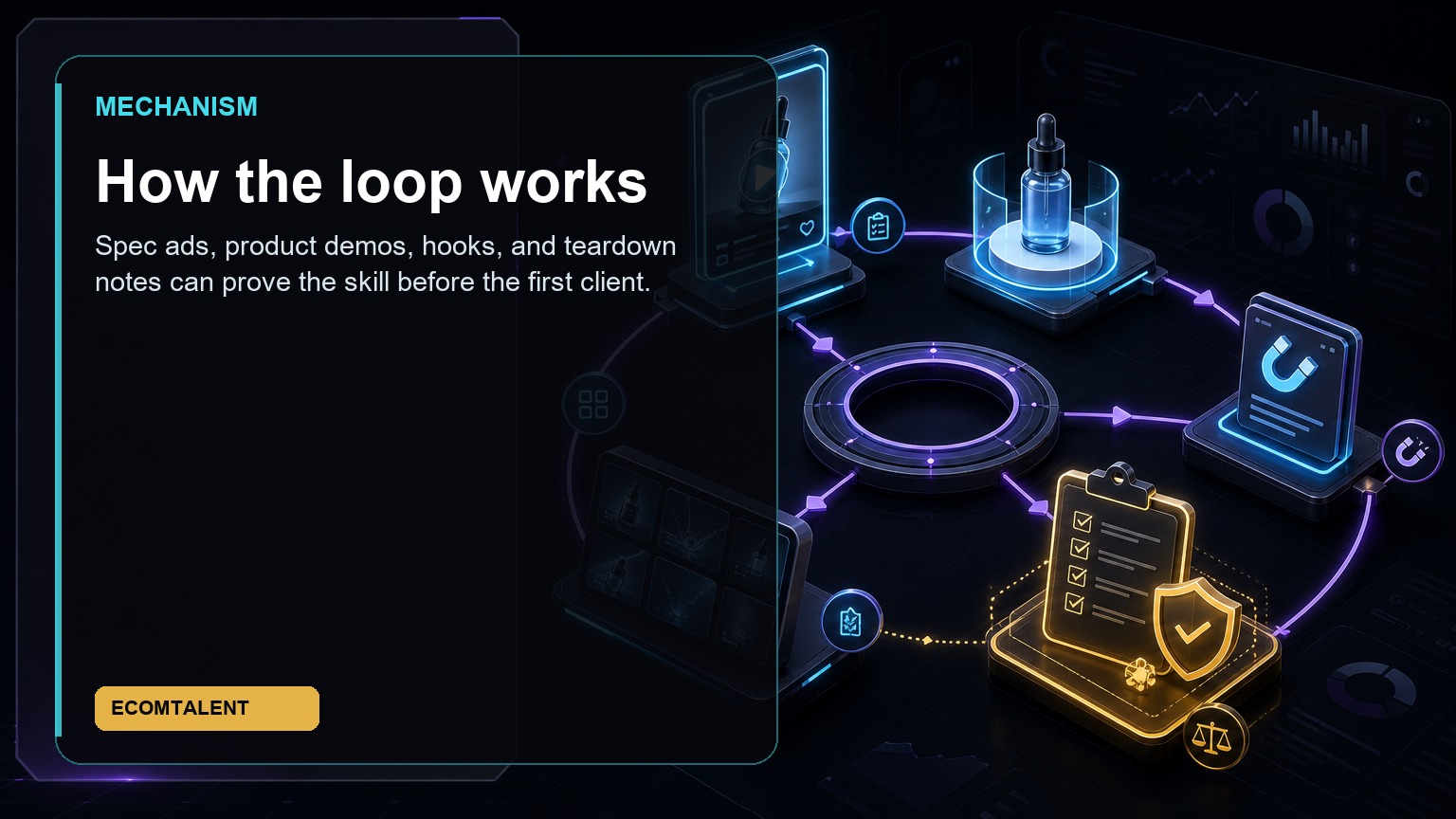
Here is where the spec-ad idea stops being a solo grind and starts compounding. The hardest part of building a portfolio alone is not filming. It is the feedback. Who tells you your hook is weak? Who tells you the product shot is too dark? Post a spec ad to your own empty page and the silence teaches you nothing.
The Ad Bounty loop, run inside EcomTalent, closes exactly that gap. Here is the mechanism, step by step:
- A pre-vetted ecommerce brand posts a brief. Real product, real ask, real market.
- A member creates an ad against that brief. This is a spec ad with a target, not a random sample.
- The brand tests the ad in the actual market. Not a teacher grading homework. The market, with real money behind it.
- If the ad drives sales, the member earns a percentage of every sale it generates. A strong ad can reportedly keep running for months, which means one good piece can keep paying long after you filmed it.
- Top performers get hired directly by brands on monthly retainers.
Read what that structure does to the false belief. You are not making spec ads into a void anymore. Every bounty submission is a portfolio piece AND a live audition AND a shot at a cut of sales, all at once. The feedback loop is not a kind stranger in the comments. It is the market itself telling you, in dollars, whether your ad works. That is the sharpest feedback there is.
The training under it matters too. EcomTalent includes 20+ hours of beginner-friendly ad-creative training, which is the difference between guessing at what a hook is and knowing. You learn the shape, then you make the piece, then the market grades it, then you make a sharper one. The loop tightens every rep. That is how a handful of strong pieces gets built faster than a lonely grind ever could.
Proof, and the math in your real currency
Let me be careful and honest here, because the villain in this space loves inflated numbers, and I will not join it.
The verifiable facts about EcomTalent at research time: 848 members. A 5.0 star rating across 284 reviews. Founded by Karlo, handle @karlocreates, a solo operator whose stated mission is scaling ecom brands with high-converting ads and showing others how to do the same. Membership runs $97 per month, with no free trial. There is also a brand tier at $997 per month, waitlisted, where brands pay to hire from the trained creator pool. Verify all of these on the live Whop listing before you act, because numbers move.
Sit with that brand tier for a second, because it is the most honest proof in the whole model. Brands pay $997 a month, from the demand side, to hire from the pool. That is not a testimonial. That is a market signal. When the buyers of a skill pay ten times what the learners of it pay, the skill has real demand behind it.
Now the buyer math. The member tier is $97 per month.
| What you are weighing | The honest framing |
|---|---|
| Cost to join, member tier | $97 per month. Ninety-seven dollars. No free trial, so month one is a real decision. |
| What UGC creators commonly charge | Reported per-video rates for beginners vary widely, often cited in the low hundreds per piece as creators build. Treat any figure as a general industry range, not a promise. |
| What the Ad Bounty adds | A percentage of the sales an ad drives, which can pay out over a reported multi-month run if the ad performs. Earnings depend entirely on performance and are not guaranteed. |
| Brand-side demand | $997 per month, waitlisted. Brands pay this to hire from the pool. |
The arithmetic is simple, and I will not dress it up. If one bounty submission over its run earns back more than a month or two of membership, the math works. If it does not, it does not. That outcome depends on your effort, your reps, and the market, none of which anyone can guarantee. What I can say plainly: the model is built so your practice and your proof are the same activity. You are not paying to watch videos. You are paying for a room where making the portfolio and getting paid for it happen in the same loop.
Where this loses, honestly
I will not pretend this is the only path or the best one for everyone. Here is where it loses.
If you have zero budget, the free path wins. You can film spec ads today, post them, and gather feedback from public comments and free creator communities without paying anyone a cent. It is slower and the feedback is noisier, but it is real, and $97 a month is not nothing when you are starting from broke. A paid community buys you a tighter loop and pre-vetted briefs. It does not buy you a skill you refuse to practice.
If you already have paying brand clients and a booked calendar, you may not need bounties to build proof. You have proof. Your leverage now is raising rates and referrals, a different problem than the one this guide solves.
And if your real goal is building your own ecommerce store, this is the wrong vertical entirely. UGC is making ads for other people's brands. Store-building is a separate craft. Do not join expecting a Shopify course. You will not find one, and you should not.
Where to be careful
- No income is guaranteed. The Ad Bounty pays on performance. If your ad does not drive sales, you do not earn a cut from it. Anyone who promises you a number is lying to you, and I will not be that person. Earnings vary and depend on your work and the market.
- $97 recurs. There is no free trial, so you are committing real money from day one, and there is no operator refund guarantee to fall back on. Set a personal deadline. If you have not shipped several bounty submissions and learned from the feedback within your first month or two, either your effort or the fit is wrong, and you should reassess rather than drift.
- The market is the grader, and it is blunt. Bounty feedback comes as sales or no sales. That is honest, but it can sting. If harsh, unsentimental feedback breaks your motivation, build a thicker skin before you build a portfolio.
- Numbers change. The 848 members, the 5.0 rating, the 284 reviews, the pricing, all of it was live at research time and all of it can move. Check the current listing yourself. Do not take my snapshot as today's truth.
- It rewards volume of reps. One spec ad will not carry you. The whole method depends on running the loop repeatedly. If you want a one-and-done shortcut, you will be disappointed, and the fault will not be the model's.
The de-risking checklist
Before you spend a dollar or film a frame, run this list.
- Can you commit to filming at least three spec ads in your first week? If not, fix your schedule before your wallet.
- Do you own three products you can film today? If yes, you have no excuse to wait on packages.
- Are you willing to reshoot the same clip eight times? If that sounds like too much, the whole method is too much, and better to know now.
- Have you watched ten winning UGC ads and noted their hooks? Do this free, before anything else.
- Can you absorb feedback that comes as "it did not sell" without quitting? Be honest.
- If you join, will you actually submit to bounties, or just watch the training? The watchers do not build portfolios. The submitters do.
Check the live listing before you join. Confirm the current price, proof, and terms on Whop, then decide whether you will actually submit ads.
See EcomTalent on Whop ->The verdict, decided both ways
Buy in if you are a true beginner who wants to be on camera, you can commit to filming and reshooting real spec ads every week, and you want the market itself, not a comment section, to tell you whether your work sells. For that person, the Ad Bounty loop collapses three slow steps, building a portfolio, getting real feedback, and getting paid, into one activity. At $97 a month with a 5.0 rating across 284 reviews and brands paying $997 to hire from the pool, the demand under it is real. Verify the current numbers, then decide.
Skip it if you have no budget and can grind the free path, if you already have paying clients, if you want passive income, or if your real goal is a store instead of ad creative. Skip it too if you will pay for access and then never ship a single bounty submission, because then you are buying videos you will not watch, and no community can fix that.
Either way, walk away from this piece holding the one true thing. The door was never locked. You do not need brand work to get brand work. You need a handful of spec ads that genuinely sell, and a loop that makes each one sharper than the last. Fill the blank document. The proof follows the work, in that order, always.
FAQ
Do I really need zero experience to start a UGC portfolio?
Yes, truly zero. A spec ad, an ad you make for a product you own without being hired, counts as a portfolio piece the moment it is good. Brands watch the video, not your history. A handful of strong spec pieces can replace a resume.
How many pieces do I need before a brand takes me seriously?
A handful. Three to five ads that genuinely sell will do more than a large follower count. Quality of the piece beats quantity of your history every time, because the hiring question is only ever "can this person make an ad that works."
What is the Ad Bounty loop, quickly?
A pre-vetted brand posts a brief, a member makes an ad, the brand tests it in the market, and if it drives sales the member earns a percentage of every sale, sometimes for months. Top performers get hired on monthly retainers. Earnings depend on performance.
Can I do this completely free instead of paying?
Yes. Film spec ads, post them publicly, and gather feedback from comments and free communities. It is slower and noisier, but it costs nothing. A paid community like EcomTalent buys you a tighter feedback loop and pre-vetted briefs, not a skill you can skip practicing.
How much does EcomTalent cost and is anything guaranteed?
The member tier is $97 per month with no free trial at research time. Nothing about income is guaranteed. Bounty earnings depend on whether your ads perform in the market. Verify the current price, member count, and 5.0 rating on the live Whop listing before you join.