
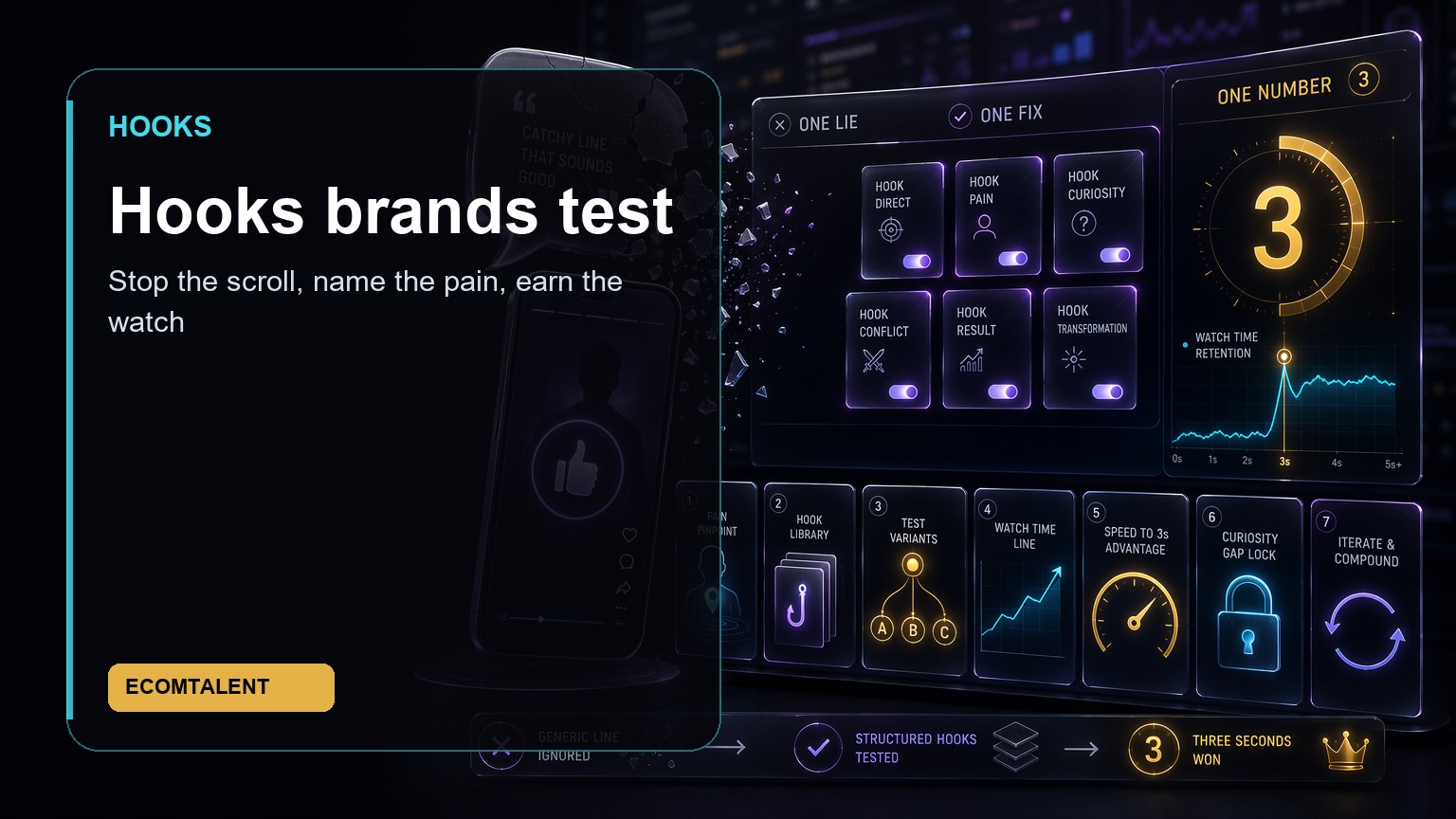
UGC ad hooks are the reason one video prints money and the identical product ad dies quietly at zero conversions. You film the same phone. Same lighting. Same product. One opens with a stranger holding it to the camera saying "here's why I returned this." The other opens with a slow logo fade. Guess which one gets watched. The scroll is a door, and the hook is your hand on the handle. Miss the first three seconds and the door slams before you say a single word about the product you spent weeks sourcing.
Here is the scene. You post the ad. You refresh the dashboard. The spend climbs, the sales do not, and the "insights" tab tells you nothing except that people saw it and left. You blame the offer. You blame the price. You lower the price. Still nothing. What actually happened is quieter and more brutal: almost nobody made it past the opening. The ad was never judged on your product. It was judged on your first sentence, and your first sentence lost.
What a UGC ad hook actually is, no fluff
A UGC ad hook is the opening moment of a user-generated-style video ad, roughly the first three seconds, that earns the next three seconds. That is the whole job. Not to explain the product. Not to close the sale. To keep the thumb from moving. UGC means the ad looks like a real person filmed it on a real phone, not a polished studio spot, because that raw texture is what the feed rewards and what viewers trust.
The hook is one unit: a visual, a spoken line, and an on-screen caption firing at the same time. Three channels, one message, three seconds. Get all three pulling the same direction and the door swings open. Let one contradict the other, a calm face over an urgent claim, and the viewer feels the seam and scrolls. The hook is not decoration bolted onto the ad. The hook is the ad deciding whether the rest of the ad gets to exist.
Who this is for, and who should close the tab
This is for you if you make UGC ads and cannot figure out why solid footage underperforms. For the ecom brand owner burning budget on creative that tests flat. For the beginner creator who wants named frameworks to copy tonight, not vague advice to "add more energy." You want examples you can steal and shoot on your phone by the weekend. That reader, we can help.
Close the tab if you want a magic line that works forever. It does not exist. Hooks fatigue, audiences shift, and what crushed last quarter gets ignored this quarter. Close the tab if you refuse to film more than one version, because the entire game is testing many hooks against the same body and letting the market pick. And close the tab if you are looking for dropshipping store-building or a Shopify course. This is about performance ad creative, the thing that runs on top of the product, not the store underneath it.
Check the live listing before you join. Confirm the current price, proof, and terms on Whop, then decide whether you will actually submit ads.
See EcomTalent on Whop ->The costly belief that is quietly draining your budget
Here is the lie almost every new creator and half the brand owners believe: a good product sells itself and the hook does not matter. It sounds humble. It sounds like craftsmanship. It is the most expensive sentence in the entire discipline, and it is costing you in dollars you can count.
Break it with a mechanism you cannot un-see. The feed does not show your ad to buyers. The feed shows your ad to the algorithm's guess at buyers, then watches what those people do in the first few seconds. If they drop, the platform reads that as "bad ad," raises your cost to reach the next person, and quietly buries you. The product never got a vote. The buyer who would have loved it never saw second three. Your beautiful product sold itself to nobody because nobody stayed long enough to meet it.
Now the pattern that settles it. Across short-form video, the widely reported pattern is that most viewers drop off in the opening seconds, the majority gone before the halfway mark of a short clip. Treat that as a general industry range, not a precise EcomTalent stat, because exact retention varies by platform, placement, and audience. But the direction is not in dispute. The opening is where the audience is lost. Which means the opening is where the money is made.
Install the true belief and keep it: the first three seconds decide whether an ad gets watched, and the hook is the highest-leverage part of the entire ad. Same product, same offer, same landing page. Swap the hook and the cost per result can move more than any tweak to the product footage ever will. The hook is not the wrapping paper. The hook is the door, and you have been leaving it shut.
Named hook frameworks you can copy tonight
Frameworks beat inspiration because you can run them on demand. Here are the ones brands test most, each with a plain example. Read them as templates. Fill in your product, your voice, your face.
1. The Callout
Name the exact person in the first breath. The feed is a crowd; the callout points a finger. Example: "If you have oily skin and everything you try makes it worse, stop." The right viewer freezes because you just described their morning. The wrong viewer leaves, which is correct, because you do not pay to keep the wrong viewer.
2. The Contrarian
Attack the thing your audience already believes. Tension buys attention. Example: "Drinking more water did nothing for my skin. This did." You have set up a small fight, and people stay to see who wins. Deliver the resolution fast or the trick curdles.
3. The Problem Snapshot
Open inside the pain, mid-scene, no setup. Example: hold up a drawer of tangled cables and say "this is why I was late every single morning." The visual and the line hit the same nerve at once. The viewer recognizes their own drawer before they recognize it is an ad.
4. The Result First
Show the after, then promise the how. Example: "Three weeks with this and my before-and-after is genuinely embarrassing." Curiosity does the rest. Warning: keep the claim honest and provable, use "reported" and "for me" language, never a guarantee, or you buy a click and lose the trust that closes it.
5. The Question Trap
Ask something the target cannot help answering in their head. Example: "Why does nobody talk about how bad most water bottles are for your teeth?" Now they need the answer, and the only place to get it is the next five seconds of your ad.
6. The Mistake Confession
Admit you got it wrong. Confession reads as honest, and honest reads as watchable. Example: "I wasted 90 dollars on the viral one before I found this." You lowered your own status, which raises your believability, which is the whole currency of UGC.
7. The Unboxing Interrupt
Start mid-action, already opening the package, already reacting. Example: "Okay it just arrived and I did not expect the box to be this heavy." Motion in frame plus a genuine reaction reads as real, and real is the format's home advantage.
8. The Direct Address
Break the fourth wall and speak to one person. Example: "You clicked away from this three times already, so let me be quick." Naming the behavior mid-scroll is jarring in the way that stops a thumb.
Notice what every one of these does. It opens the door before it mentions the product. The product walks through the door second. That order is the entire lesson.
The mechanism: how hooks actually get proven, the Ad Bounty loop
Use the same filter before you join. Check the live Whop listing, confirm the current price and proof, then decide whether you will actually submit ads.
Check EcomTalent on Whop ->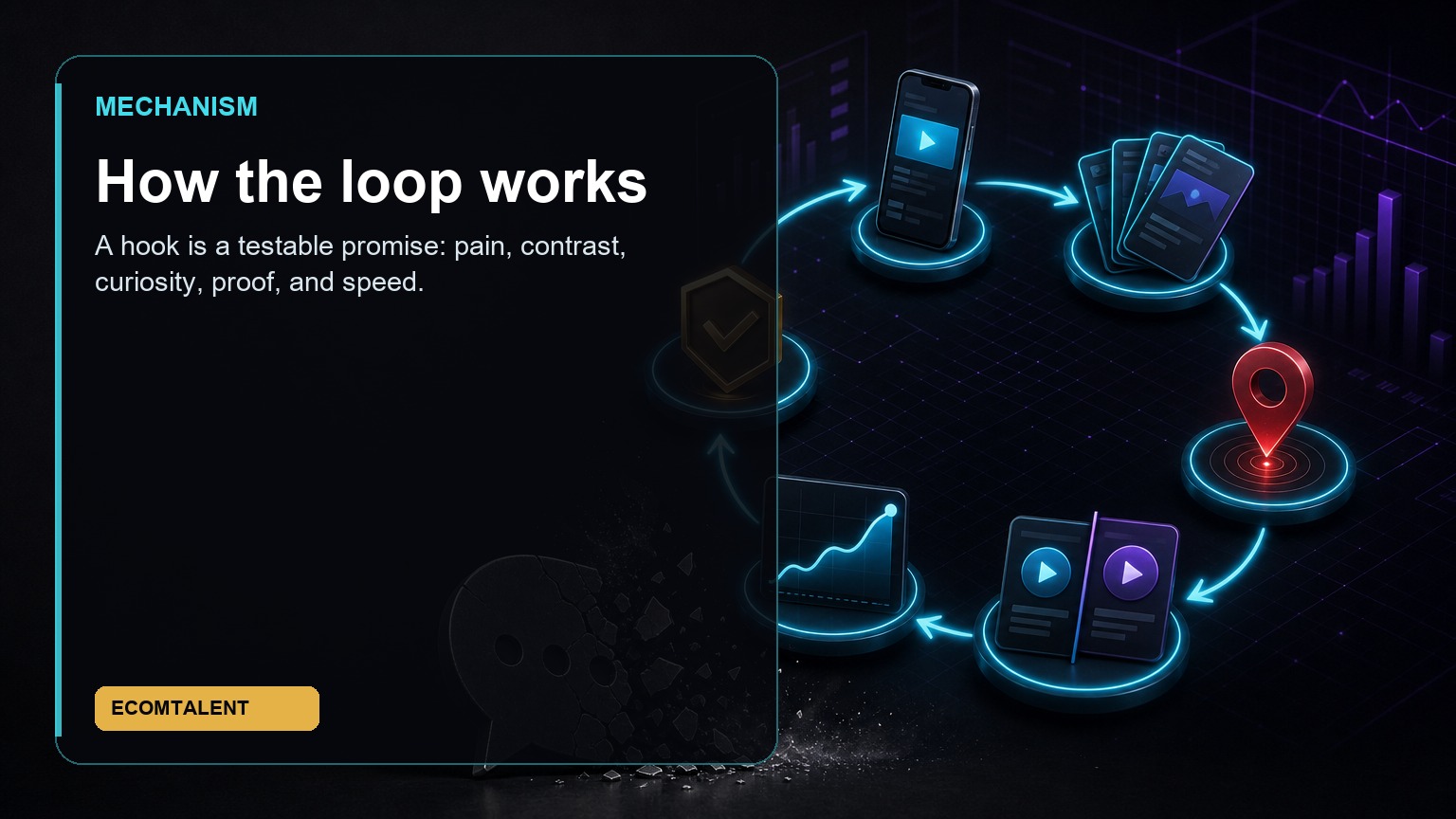
Frameworks are theory until the market votes. So how do the best creators know which hook wins before they bet a month of budget on it? They put it in front of real brands testing real spend. That is the mechanism worth understanding, and it is the spine of what EcomTalent teaches, the community built by Karlo (@karlocreates).
Here is the loop, numbered and plain. It is called the Ad Bounty loop.
- A pre-vetted ecom brand posts a brief. A real brand, already screened, drops the product, the angle, and what it needs from the creative.
- A member creates the ad. You film the hook variations against the same body, using the frameworks above.
- The brand tests it in market. Real ad spend, real audience, real retention data. Not your opinion, not the group's opinion, the feed's verdict.
- If the ad drives sales, the member earns a percentage of every sale it generates. A winning ad can keep running for months (reported, and it varies by brand), which means one strong hook can pay out long after you filmed it.
- Top performers get hired directly. Brands pull the best creators onto monthly retainers, which flips you from chasing gigs to fielding offers.
See why the hook is the leverage point now? In this loop you are paid on what the ad drives, not on how long you spent filming. A better opening does not just raise your view rate. It raises the sales the ad generates, which raises your cut, which compounds across every month that ad keeps running. The hook is the door, and in the Ad Bounty loop the door has your name on the paycheck taped to the other side.
Proof and the buyer math, in dollars you can count
Numbers, framed as evidence, not as promises. At research time EcomTalent shows 848 members and a 5.0 star rating across 284 reviews on its Whop listing. Verify the current figures on the listing yourself, because they move. A rating that high across that many reviews is not proof you will earn; it is evidence the training and the loop are landing for the people inside. Read it as a signal, not a guarantee.
The training itself is 20-plus hours of beginner-friendly ad-creative instruction, built so someone who has never shot a hook can shoot one. And the demand side has its own tell: brands pay 997 dollars a month, with a waitlist, to hire from this trained creator pool. When the buyers of your work are lining up and paying to reach you, that is the market pricing the skill, not a testimonial you have to trust.
Now the buyer math on the member tier, in your currency. The membership is 97 dollars a month. Ninety-seven dollars. No free trial, and no operator refund guarantee beyond the Whop platform default, so go in knowing that. Here is the arithmetic that matters: what does one placed ad have to do to cover the seat?
| Item | Figure | Note |
|---|---|---|
| Member tier | $97 / month | Verified. No free trial. |
| Brand tier (demand side) | $997 / month, waitlist | Verified. Brands pay to hire the pool. |
| Training depth | 20+ hours | Verified. Beginner-friendly. |
| Ad Bounty payout basis | % of sales the ad drives | Verified mechanism. Amount varies by brand, offer, and ad performance. |
| Winning-ad runtime | Reported to run for months | Reported range, varies. Not every ad wins or runs that long. |
| Members / rating | 848 / 5.0 stars / 284 reviews | Verified at research time. Confirm live on the listing. |
The percentages and per-ad earnings are not fixed and depend entirely on performance, the brand, and the offer, so treat any dollar figure you calculate as your own scenario, not a promise from EcomTalent. What the math shows is the shape of the bet: a single ad that gets tested, wins, and runs for months earns on every sale for that whole run. The break-even question is not "will I get rich." It is "can one placed hook out-earn a 97-dollar seat." For the members whose ads win, the answer is structurally yes. For members whose ads never place, the answer is no, and that honesty is the point.
Where UGC hooks lose, and what beats them
A hook is the highest-leverage part of the ad. It is not the only part, and pretending otherwise is its own lie. Here is where the hook stops mattering and something else takes over.
A killer hook on a broken offer still fails. If the product is overpriced for what it does, the hook buys you a click and the landing page loses the sale. The hook cannot fix bad economics. A brilliant opening in front of the wrong audience also dies, because relevance beats craft; a mediocre hook shown to the perfect buyer outperforms a genius hook shown to strangers. And retention past the hook is its own skill. You can open the door and still bore the viewer out of it by second eight. The hook wins the first three seconds. The next twenty are a separate fight, and a weak body ad will squander every viewer the hook earned.
So what beats a great hook? A great hook plus a tested body plus a real offer plus the right audience. The hook is first among equals, the leverage point, the door. It is not the whole house.
Where to be careful
- Claims are a legal surface. "Result first" and "mistake confession" hooks flirt with promises. Use "reported," "for me," "may," and "results vary." A hook that overclaims can get the ad rejected or worse, and it torches the trust that UGC runs on.
- Hooks fatigue fast. The winner this month gets ignored next month as the audience sees it too often. Plan to keep generating new openings against the same body, not to find one line and ride it forever.
- The format punishes fakeness. A hook that feels staged reads worse than a plain one that feels real. UGC's whole edge is authenticity, and a viewer smells a performance in about one second.
- Earnings depend on placement. In any bounty-style loop, you get paid when your ad wins and runs. Ads that do not place pay nothing. Budget your time and your 97 dollars knowing that outcomes vary and are not guaranteed.
- No free trial, limited refund. The member tier is 97 dollars a month with no trial and no operator guarantee beyond Whop's default. Decide before you pay, not after.
The checklist that de-risks your next hook
- Does the opening line name the target or their exact problem in the first breath?
- Do the visual, the spoken line, and the caption all fire in the first three seconds and agree with each other?
- Did you shoot at least three different hooks against the same body?
- Is every claim hedged honestly, no naked guarantees?
- Does the hook look filmed on a phone by a real person, not staged?
- Does the product appear after the door opens, not before?
- Are you letting real spend and retention pick the winner, not your own taste?
Seven boxes. Miss the first two and it does not matter how good boxes three through seven are, because the door stayed shut.
Check the live listing before you join. Confirm the current price, proof, and terms on Whop, then decide whether you will actually submit ads.
See EcomTalent on Whop ->Verdict: buy or skip
Buy EcomTalent if you want to make UGC ad creative, you will shoot multiple hooks, and you want your work tested by real brands with real spend through the Ad Bounty loop rather than guessing in a vacuum. At 97 dollars a month against a demand side where brands pay 997 to hire the pool, the structure favors the creator who shows up and iterates. The 5.0 rating across 284 reviews says the people doing exactly that are finding it worth the seat. Go verify those numbers on the listing, then decide.
Skip it if you want passive income without filming, if you refuse to test more than one version, if you need a guaranteed payout, or if you are hunting a dropshipping or store-building course, because this is not that. This is performance ad creative, the craft of the hook and the loop that pays for it.
The scroll is a door. Your product is a good guest. But the guest never gets inside until the hook opens the door, and for too long you have been polishing the guest while leaving the door shut. Open it.
FAQ
What is a UGC ad hook?
It is the opening moment of a user-generated-style video ad, roughly the first three seconds, whose only job is to stop the scroll and earn the next few seconds. It combines a visual, a spoken line, and a caption firing together.
How long should a hook be?
Think in terms of the first three seconds, because that is where most short-form viewers decide to stay or leave, a widely reported general pattern. If the opening has not landed by then, the rest of the ad rarely gets watched.
Do hooks really matter more than the product?
For getting the ad watched, yes. The feed judges the opening seconds before the buyer ever meets the product. A great product with a weak hook gets buried; the hook is the highest-leverage part of the ad. The product still has to be good to close the sale.
What is the Ad Bounty loop in EcomTalent?
A pre-vetted brand posts a brief, a member creates the ad, the brand tests it in market, and if it drives sales the member earns a percentage of every sale it generates. A winning ad can keep running for months, reported and variable, and top performers get hired directly on monthly retainers.
How much does EcomTalent cost?
The member tier is 97 dollars a month with no free trial and no operator refund guarantee beyond the Whop platform default. There is also a 997-dollar-a-month brand tier, on a waitlist, for brands hiring from the creator pool. Confirm current pricing on the listing.
Will I definitely make money?
No. Earnings depend on whether your ads place and perform, which varies by brand, offer, and performance. Ads that do not win pay nothing. Treat any income figure as a scenario, never a promise.